
Outside view
I. Time Allotment
2 periods
II.Teaching Objectives and Requirements
1. Develop the Ss’ awareness of thinking about mind maps;
2. Ask Ss to remember useful words and expressions;
3. Strengthen Ss’ ability to do the prediction task;
4. Provide Ss some information about how to give a public speech.
III. Teaching Procedures
Step 1 Background information about mind maps.
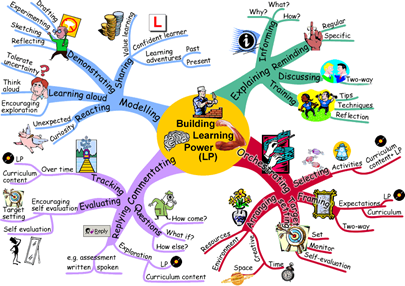
Mind maps or graphic “webs” have been used for centuries:
There are examples of similar graphic techniques by ancient Greeks and medieval philosophers. Modern mind-mapping is said to have been developed by Alan Collins in the late 1950s and was promoted by Tony Buzan in the 1960s and later in popular books about memory and study skills.
Definition: A mind map is a diagram used to represent words, ideas, tasks, or other items linked to and arranged around a central key word or idea. Mind maps are to generate, visualize, structure, and classify ideas.
Step 2 Warming-up activity: try to predict the answers.
1 What is a mind map?
2 Have you ever used one?
3 Why do we use them?
4 What are the advantages of using mind maps over writing notes?
Step 3 Go through the vocabulary list and students can be familiar with it.
New words
generate v. 引起,引发
structure v. 计划,组织,安排
brainstorm v. 自由讨论,集体解决难题
brainstorming n. 集思广益,献计献策
overview n. 概述,概观
revision n. 复习
solve v. 解决(问题)
option n. 选择,供选择的东西
perspective n. 看法,观点,视角
creative a. 有创造力的,有想象力的
laterally ad.(思维)横向地
illogical a. 不合逻辑的
noticeable a. 显而易见的,明显的
feature n. 特点,特征
spiral v. 螺旋形行进
radiate v. 辐射,发射
issue n. 议题,争论点
highlight v. 突出
bubble n.(漫画中用于圈起人物所说的话的)对话框
identify v. 识别,(经考虑)确定
Step 4 Detailed study of the passage.
A. Watch Part 1 and correct the sentences according to what you hear from the clip.
1. Mind maps are diagrams which help us to discuss ideas, and also to organize or structure our ideas related to a topic.(generate)
2. OK, brainstorming is the most important use of mind maps.(one of the most important uses)
3. By using mind maps to collect the main ideas from what the teacher says, you can keep a very good idea of a topic …(general understanding)
4. Before an exam, after having only studied for a short time, you might want to capture the very general understanding about the subject. (many, many days or even weeks)
5. They give us almost a picture, a different perspective in terms of a picture, or a diagram of understanding information or understanding connected ideas, which is very helpful for people who like to learn in their own way. (from a different way)
6. As you can see, we have long texts throughout our mind map. (main ideas)
7. Mind maps are very logical and therefore they encourage us to think creatively, you might say.(illogical)
B. Now watch Part 2 of the video clip and write down the students’ responses to the sentences spoken by the teacher.
1. And then I’d just like you to have a look at this mind map and tell me what some of the most noticeable or striking features are that we can talk about.
2. What else do you notice about the design of this mind map?
3. What other aspects of design do you notice here?
4. Are there any other aspects of design which you notice in this particular map?
Step 5 Writing
Write a short summary of the video clip, which should include: what mind maps are;
the advantages of mind maps
Step 6 Assignments
A. oral homework
Talk about the uses of mind maps(e.g.note-taking, problem solving, decision making, and writing.)
Talk about the advantages of mind maps (e.g. give a quick summary, enable creative thinking ...)
B. Design a piece of mind maps about the topic which students are interested in.
Design: How can you mind map? Below is a step by step process on how you can create a mind map.
Step 1: Grab some coloured pens / pencils, a blank piece of paper and turn it sideways. In the centre of the page draw the first image that comes to mind on the topic you are mindmapping. Label the image.
Step 2: Branch off from your central image and create one of your main ideas (think of each branch as being like a chapter in a book). Label the branch. You can also draw a picture for it.
Step 3: From your main branches draw somesub-branches and from those sub-branches you can draw even more branches. What you are beginning to do is create associations between ideas.
Step 4: Draw pictures for each branch or for as many branches as possible. Make each picture as absurd, funny and / or exaggerated as possible. The reason for this is that we think in pictures and remember vivid, exaggerated images more easily.
Step 5: Draw another main branch but this time use a different colour. Colour helps to separate out different ideas and keeps your mind stimulated. Draw sub-branches and pictures. If you get bored at any stage, move on and create another branch.
Step 6: Keep repeating the above process (different colours, main branch, sub-branches and absurd pictures).
Make sure each branch is curved and not a straight line. The brain is more stimulated by curved lines.
C. Disscussion
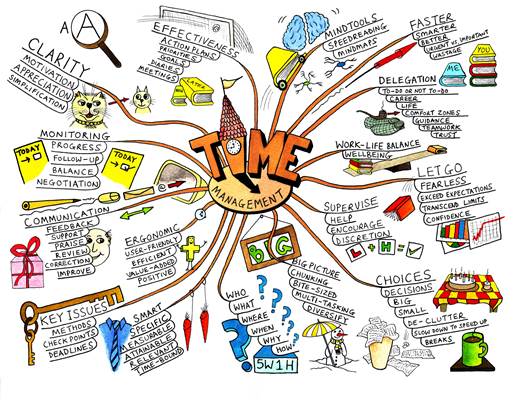
Look at the above mind map and answer questions quickly.
What is the central word in this mind map?
How many branches does this mind map have?
How many different colors does this mind map use?
Any other noticeable features?

