
目录

  • 1 Starting out
    • 1.1 An Introduction about Listening(课程导入)
    • 1.2 Inside view(课程内容)
    • 1.3 English Names(第一小节知识补充)
    • 1.4 Outside view (课程内容)
    • 1.5 Oxford University (第二小节知识补充)
    • 1.6 Listening in(课程内容)
    • 1.7 The IVY league(第三小节知识补充)
    • 1.8 Pronunciation(语音练习)
    • 1.9 Ideological and Political Elements of the Unit(单元思政元素挖掘)
    • 1.10 Video Clip of Language and Cultural Point(教师单元知识点精讲视频)
    • 1.11 Language Output of the Unit(语言产出任务布置)
    • 1.12 Peer Assessment(同伴互评)
    • 1.13 Scripts for Unit 1(听力原文)
    • 1.14 Cultural Awareness(文化意识提升)
    • 1.15 Quiz (单元测试)
  • 2 Food, glorious food
    • 2.1 Differences in Food Culture(课程导入)
    • 2.2 Inside view (课程内容)
    • 2.3 Translation for Eight Chinese Cuisines(第一小节知识补充)
    • 2.4 Outside view (课程内容)
    • 2.5 Listening in(课程内容)
    • 2.6 Differences between Western and Chinese Table Manners(第三小节知识补充)
      • 2.6.1 BBC: Table manners I(课外知识补充)
      • 2.6.2 BBC: Table manners II(课外知识补充)
    • 2.7 Pronunciation(语音练习)
    • 2.8 Ideological and Political Elements of the Unit (单元思政元素挖掘)
    • 2.9 Video Clip of Language and Cultural Point(教师单元知识点精讲视频)
    • 2.10 Language Output of the Unit(语言产出任务布置)
    • 2.11 Peer Assessment(同伴互评)
    • 2.12 Sripts for Unit 2(听力原文)
    • 2.13 Cultural Awareness(文化意识提升)
    • 2.14 Quiz(单元测试)
  • 3 Learning to think
    • 3.1 Six Thinking Hats(课程导入)
    • 3.2 Inside view(课程内容)
    • 3.3 Memory (第一小节知识补充)
    • 3.4 Outside view(课程内容)
    • 3.5 Mind maps(第二小节知识补充)
    • 3.6 Listening in (课程内容)
    • 3.7 Backgroung information about Nursery school(第三小节知识补充)
    • 3.8 Pronunciation(语音练习)
    • 3.9 Ideological and Political Elements of the Unit (单元思政元素挖掘)
    • 3.10 Video Clip of Language and Cultural Point(教师单元知识点精讲视频)
    • 3.11 Language Output of the Unit(语言产出任务布置)
    • 3.12 Peer Assessment(同伴互评)
    • 3.13 Scripts for Unit 3(听力原文)
    • 3.14 Quiz(单元测试)
  • 4 Family affairs
    • 4.1 Family Education(课程导入)
    • 4.2 Inside view(课程内容)
    • 4.3 Parents' Roles in Family Education(第一小节知识补充)
    • 4.4 Outside view(课程内容)
    • 4.5 The changing role of fathers(第二小节知识补充)
    • 4.6 Listening in(课程内容)
    • 4.7 Nature and Nurture(第三小节知识补充)
    • 4.8 Pronunciation(语音练习)
    • 4.9 Ideological and Political Elements of the Unit (单元思政元素挖掘)
    • 4.10 Language Output of the Unit(语言产出任务布置)
    • 4.11 Students‘ Language Output Presentation(学生语言产出成果展示)
    • 4.12 Peer Assessment(同伴互评)
    • 4.13 Scripts for Unit 4(听力原文)
    • 4.14 Cultural Awareness(文化意识提升)
    • 4.15 Quiz(单元测试)
  • 5 Revision and Exam(期中测试)
    • 5.1 Test paper (测试样题)
  • 6 News 24/7
    • 6.1 Background information about News(课程导入)
    • 6.2 Inside view(课程内容)
    • 6.3 News(第一小节知识补充)
    • 6.4 Outside view (课程内容)
    • 6.5 Life story about Dianna (第二小节知识补充)
    • 6.6 Listening in(课程内容)
    • 6.7 Reality TV Program(第三小节知识补充)
    • 6.8 Pronunciation(语音练习)
    • 6.9 Language Output of the Unit(语言产出任务布置)
    • 6.10 Students‘ Language Output Presentation(学生语言产出成果展示)
    • 6.11 Peer Assessment(同伴互评)
    • 6.12 Scripts for the Unit (听力原文)
    • 6.13 Key to exercises(参考练习答案)
    • 6.14 Cultural Awareness(文化意识提升)
    • 6.15 Quiz(单元测试)
  • 7 Arrivals and departures
    • 7.1 Modern Beijing Self-Guided Tour (课程导入)
    • 7.2 Inside view (课程内容)
    • 7.3 Preparation for Hiking(第一小节知识补充)
    • 7.4 Outside view (课程内容)
    • 7.5 The Trip to Australia(第二小节知识补充)
    • 7.6 Listening in (课程内容)
    • 7.7 The Trip to the USA(第三小节知识补充)
    • 7.8 Pronunciation(语音练习)
    • 7.9 Ideological and Political Elements of the Unit(单元思政元素挖掘)
    • 7.10 Language Output of the Unit(语言产出任务布置)
    • 7.11 Students‘ Language Output Presentation(学生语言产出成果展示)
    • 7.12 Peer Assessment(同伴互评)
    • 7.13 Scripts for the unit (听力原文)
    • 7.14 Key to exercises(参考练习答案)
    • 7.15 Cultural Awareness(文化意识提升)
    • 7.16 Quiz (单元测试)
  • 8 All you need is love
    • 8.1 Love(课程导入)
    • 8.2 Inside view(课程内容)
    • 8.3 Dating(第一小节知识补充)
    • 8.4 Outside view(课程内容)
    • 8.5 Listening in (课程内容)
    • 8.6 True Love(第三小节知识补充)
    • 8.7 Pronunciation(语音练习)
    • 8.8 Ideological and Political Elements of the Unit (单元思政元素挖掘)
    • 8.9 Language Output of the Unit(语言产出任务布置)
    • 8.10 Students‘ Language Output Presentation(学生语言产出成果展示)
    • 8.11 Peer Assessment(同伴评价)
    • 8.12 Scripts for the unit(听力原文)
    • 8.13 Cultural Awareness(文化意识提升)
    • 8.14 Quiz(单元测试)
  • 9 Body and mind
    • 9.1 What is Health?(课程导入)
    • 9.2 Inside view(课程内容)
    • 9.3 Factors for good health(第一小节知识补充)
    • 9.4 Outside view(课程内容)
    • 9.5 Preserving Health(第二小节知识补充)
    • 9.6 Listening in (课程内容)
    • 9.7 The China Health and Nutrition Survey (第三小节知识补充)
    • 9.8 Pronunciation(语音练习)
    • 9.9 Ideological and Political Elements of the Unit (单元思政元素挖掘)
    • 9.10 Language Output of the Unit(语言产出任务布置)
    • 9.11 Students‘ Language Output Presentation(学生语言产出成果展示)
    • 9.12 Peer Assessment(同伴互评)
    • 9.13 Scripts for the unit(听力原文)
    • 9.14 Key to exercises(参考练习答案)
    • 9.15 Cultural Awareness (文化意识提升)
    • 9.16 Quiz (单元测试)
  • 10 Revision and Final Examination (学期测试)
    • 10.1 Exam Paper(测试样题)
Inside view (课程内容)


 Inside View


I. Time Allotment

   2 periods

II.Teaching Objectives and Requirements

1. Develop the Ss’ awareness of involving of talking about some food names, especially Western food names.

2. Ask Ss to memorize some useful expressions about food;

3. Strengthen Ss’ ability to listen for the specific information, such as sb's like or dislike;

4. Provide Ss some information about how to order or ask about food.

III. Teaching Procedures


Conversation 1

Step 1 To be familiar with the new expressions in the conversation.  

spicy a.(食物)辛辣的

curry n. 咖喱

spice n. 香料,调味品

selection n. 供挑选的东西

moussaka n. 莫萨卡(由碎肉、茄子和奶酪做成的希腊菜肴)

bake v. 烘,烤焙

oven n. 烤炉,烤箱

starter n.(一餐的)第一道菜

minestrone  n. 意大利浓菜汤

pasta  n. 意大利面食

prawn n. 对虾,明虾

garlic  n. 蒜

chilli con carne  n. 辣味肉末

Step 2.  Guess work: here are three main courses. Please tick (✓) the ingredients and flavor of each main course.

      ingredients  and flavor


    vegetables


meat


  hot


sweet 


  spicy

    moussaka


   chilli con  carne


   chicken curry


Step 3  Role-play

Work with your group members and do a role-play using the completed table in Activity 3: 

A acts as the interviewer, 

B is Janet, 

C is Kate,  

D is Mark. 

A asks the questions and B, C and D explain the dishes. Then act out the conversation to the whole class.


Conversation 2

Step 1 To be familiar with the new expressions in the conversation.  

strudel  n. 果馅卷

pastry  n. 油酥点心

keen a. 渴望的,迫切想要的

brownie  n.(小方块)巧克力蛋糕

flavour  n. 味,味道

vanilla  a. 香草制的,香草味的


Step 2  Making a prediction 

Ask students to predict: what they’re going to eat next

Example answers

1. Janet has had minestrone soup and chicken curry.

2.  Kate has had minestrone soup and moussaka.

 3. Mark has had the prawn with garlic and chilli con carne.

 4.I think they will have some ice cream.

5. I guess they will have some kind of dessert.


Step 3 Group work

   Students are divided into different groups, each group has 3 students. Student A focuses on what Kate says;  Student B concentrates on Janet; and C pays special attention to Mark. In answering the questions, use the following words and expressions.

Step 4 Talking about Language and culture 

 In Britain and the US, many bars and restaurants offer dishes from all over the world. However, if you especially like French, Italian, Lebanese, Indian or Chinese food, you can choose restaurants which specialize in this kind of cooking. There are Chinese restaurants in most big cities in the West. 

  Most meals have two or three courses: a starter, a main course and a dessert. The dessert is usually something sweet

Step 5  A. Practice with Everyday English
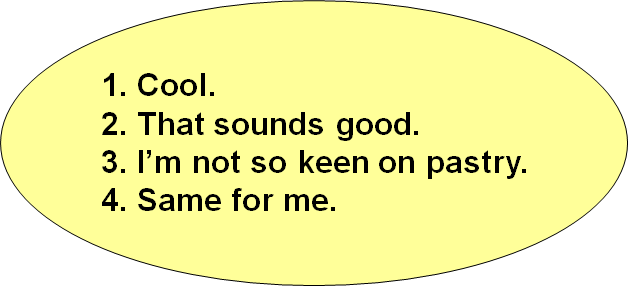

B. Practice with expressions on talking about food

What’s minestrone soup /  Peking duck?

What’s it made with?  It’s made with …

What’s in it?

How is it cooked?

It’s baked / boiled / fried / cooked in …

What flavour ice cream do you have?

C. Practice with expressions on saying food you like or dislike

It’s delicious / tasty / spicy / hot!

That sounds good.

I don’t like …

I’m not so keen on …

I’m not very fond of …