
Listening in
I. Time Allotment
2 periods
II. Teaching Objectives and Requirements
1. Develop the Ss’ awareness of involving of talking about table manners;
2. Ask Ss to summarizes their ideas;
3. Strengthen Ss’ ability to listen for the giving advices;
4. Provide Ss some information about how to describe table manners.
III. Teaching Procedure
News report
Step 1 To be familiar with the vocabulary list.
release v. 公布,发布
dietary a. 饮食的
guidelines n. 指导方针
revise v. 修订
nutritious a. 有营养的
dairy a. 奶制的
lean a. 脂肪少的
protein n. 蛋白质
calorie n. 卡路里
teaspoon n. 茶匙
milligram n. 毫克
sodium n. 钠
Step 2 Ask some students to give one question at a time and other students to give answers.
Step 3 Summarize the group's ideas.
Passage 1
Step 1 Read and conduct the questionnaire:
Work in pairs: A asks the first four questions and B answers very quickly; then B takes turns to ask the rest of the questions and A gives quick responses.
Some example answers:
I don’t mind really, but it may be less expensive, more cosy to have dinner at home.
They invite me for dinner at 6 pm. I can arrive at about 6.30 pm or even 6.45 pm.
Before we eat, I chat with everyone there. In a restaurant,we may discuss what to order or what has been ordered. At home, we may be offered something to drink.
Step 2 Go through the vocabulary list, make students familiar with it for a better understanding of the passage.
New words
entertain v. 招待,款待
hospitality n. 热情
barbecue n. 烧烤
campsite n. 营地
vegetarian n. 素食主义者
frustrated a. 受挫的,懊恼的
elbow n. 肘
Step 3 Write down the number of the questions they're answering.
Ben, from the US __________________________
Michelle, from France _______________________
Tom, from the UK __________________________
B. Fill in the blanks.
Ben If it’s a formal meal, maybe Thanksgiving or Christmas, or if you’re with your boss or someone like that, you are being careful about your table manners. So you’d wait until everyone is served before you eat. But most of the time, if you know each other well you would just (1) ______and start. It’s more usual to entertain them at home because it shows your hospitality. We have a lot of barbecues outside, maybe in the garden or maybe at a campsite. But sometimes if you don’t want to cook, you can go to a (2)__________. Oh, well, after dessert you’ll have a little talk, then talk some more, have some coffee. Then you’ll say, “Oh well, it’s time for us, we should get going.” And if you don’t, then you’re probably going to be rude and (3) _________________.
Michelle Well, it would be between 8 and 8.30. It is unusual that if somebody is invited for 8 they would be there at 7.30 or 7.45. Probably 8, or 8.30 would be when all the guests (4) _______________. It’s OK to refuse something if you don’t like it, but it might be embarrassing. For example, if I’m cooking dinner and I discover one of my guests is a vegetarian, I’ll feel a bit frustrated that I didn’t know before. But usually (5) __________________________.
Tom Well, usually the host serves the guests, so you should make sure you tell him or her not to give you too much, because yes, it’s quite important to eat everything on your plate. It doesn’t matter if you leave something, but if you leave a lot, it will look as if (6) you don't ____________. My mother always told me to put my hands on my lap, under the table when I wasn’t eating, and I would be in big trouble if I ever put my elbows on the table. But actually I know that in some countries (7) ___________________. So I might ... No, it’s the worst thing you can do if you’re eating. Any strange noises are absolutely forbidden. I mean you can say “mmm, this is good”, but (8)______________________. ...
Step 4 Talk about dining cultural differences
At a Chinese Table:
Food is shared. Never take the last piece of food from a common plate. Make sure to place your chopsticks horizontally over your bowl or plate and not lay them on the table or, even worse, stick them vertically into the rice bowl. Respect seniority. Take food for the elders before taking it for yourself. If someone raises a toast, make sure that when you clink glasses with someone older than you that the rim of your glass is lower than that of the senior person to show your respect.
At a Western Table:
Pick up the knife with your right hand and the fork with the left, with the handles in the palms of your hands. Lift food to your mouth with the fork, always keeping the tines pointing down. Never use the fork like a spoon (with the tines pointing upwards). Never put the knife near your mouth. Place your dinner napkin in your lap. Gently dab your mouth with the napkin before taking a drink. This prevents food pieces from falling into your glass. Place your napkin to the left of your plate if you leave the table and intend to return. Push your chair in. Don’t use the napkin to wipe your entire face. Never use your napkin as a handkerchief.
Step 5 Critical thinking
Passage 2
Step 1 Warming-up activities
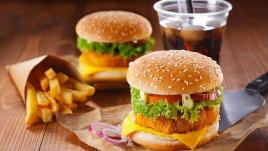
Work in pairs and discuss the questions.
1) What is junk food? Do you ever eat it?
2) What junk food ads do you see on television?
3) What types of people are the ads aimed at?
4) Do you belong to any of these types of people?
Step 2 Brief introduction about junk food
垃圾食品(Junk Food),是指焦糊、高油、高盐、高糖的食品,提供超过人体需要,变成人体多余成分的食品。
油炸类食品主要危害是:1、油炸淀粉导致心血管疾病;2、含致癌物质;3、破坏维生素,使蛋白质变性。
腌制类食品主要危害是:1、导致高血压,肾负担过重,导致鼻咽癌;2、影响粘膜系统(对肠胃有害);3、易得溃疡和发炎。
加工类肉食品(肉干、肉松、香肠等)主要危害是:1、含三大致癌物质之一:亚硝酸盐(防腐和显色作用);2、含大量防腐剂,加重肝脏负担
饼干类食品(肉干、肉松、香肠等)主要危害是:1、含三大致癌物质之一:亚硝酸盐(防腐和显色作用);2、含大量防腐剂,加重肝脏负担
Step 3 Go through the vocabulary list and students can be familiar with them.
New words
junk food 垃圾食品
over the top 过头的,不合适的
revenue n. 收入,收益
nutrition n. 营养
teenage a. 十几岁的
trendy a. 非常流行的,时髦的
masculine a. 男子气概的,男子汉的
nutritionist n. 营养学家
sum … up 总结,归纳
Step 4 Detailed study og the passage
Step 5 Critical thinking
Work in pairs and discuss the questions, students can use the expressions of the following words bank.
Do you think junk food advertising should be banned?
What would be the effect of a ban on junk food advertising?
Words Bank
influence; revenue;
interest; attractive / tempting;
TV stations; commercials;
make money;
do good / harm to …;
bring benefits /
negative effects to …;
to satisfy / meet …

