
Outside view
I. Time Allotment
2 periods
II.Teaching Objectives and Requirements
1. Develop the Ss’ awareness of involving of talking about their university life;
2. Ask Ss to make predictions;
3. Strengthen Ss’ ability to listen for the specific information;
4. Provide Ss some information about how to hold an informal discussion.
III. Teaching Procedures
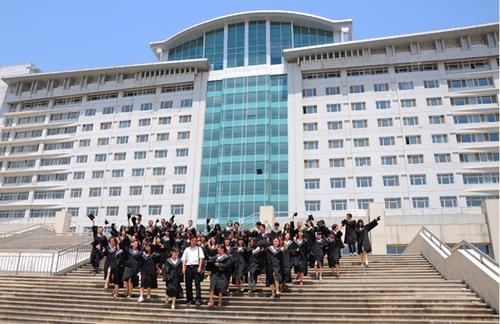
Step 1 Looking at some pictures about university and ask students to talk about their university life here.
Step 2 Watch the video clip made by the teacher and try to figure out the exact answers to the questions.
Disscussion
What is happening in the video clip?
What do you think the event happens?
How many traditions mentioned in the video clip?
Step 3 Detailed study of the outside view
Language and culture points
1. modern languages
It normally means that students study two languages, probably chosen among French, German, Spanish, Italian, sometimes among Portuguese, Dutch, Swedish or Eastern European languages. “Modern” is distinct from “Classics” (Latin and Greek) and, usually, from “Oriental” languages (Chinese, Japanese, Korean and so on).
2. Conservative and Liberal
Conservative is a general term to describe social or political attitudes in which people are not willing to accept much change, especially in the traditional values of society.
Liberal is a social or political philosophy or attitude which shows openness to new ideas about progress or reform and change if most people want it.
3. Summer Eights
It is an annual series of rowing events over four days in which teams from different Colleges compete in races on the River Thames. An “eight” is a rowing boat with eight oarsmen (or women) and a cox (who steers the boat). The best-known race is the Oxford versus Cambridge Boat Race on the River Thames. Members of the first teams for rowing and other sporting events between Oxford and Cambridge receive the sports honour of a blue. Dark blue represents Oxford and light blue represents Cambridge.
4. The Oxford Union
It is a university debating society (similar to the Cambridge Union Society at Cambridge University). Dating from 1823, it provides a forum for sophisticated debating of ideas among students. The Oxford Union has featured many world-class speakers, including many prime ministers and presidents of different countries, and has been a place where many of Britain’s famous speakers have developed their eloquence. Before each formal debate there is a 45-minute optional informal debate for students on a current issue (the topic is chosen a few days ahead by members). This gives first-time speakers a chance to practise their debating skills. The formal debate features a motion, or proposal, with two main speakers who support it and two who oppose it. After their contributions other students speak or ask questions before votes are taken for and against the motion. Topics for the debate may be political or ethical issues or controversial topics, or simply light-hearted topics (for example,This House accepts that aliens exist)
5.Subfusc
Sub fusc refers to the formal academic dress worn during exams and degree ceremonies. The term comes from the Latin subfuscus, meaning “dark clothes”. The gowns date from the Middle Ages, when scholars were members of the Church and wore ecclesiastical clothes to classes.
Answer the questions.
1 Were Julie Dearden and Eugene Berger both students at Oxford?
2 What are the Oxford traditions associated with?
3 What is Formal Hall?
4 What traditions make Oxford unique according to Eugene Berger?
Work in pairs. Student A reads the completed sentence and then Student B asks a conversational question to follow up the statement, then A and B exchange roles for the next sentence, and so on.
For example:
Student A: My name’s Eugene Berger,I studied here in Oxforfor four years, studying modern language at Somerville College.
Student B: Oh, really, which languages did you study?
Student B: It’s a very beautiful evening because there’s a specialmeal and we eat by candlelight.
Student A: What sort of food do you have for this special meal?
Step 4 Developing critical thinking
Step 6 Game
Fun game: I (do not) love Oxford traditions because they …
Each group can use “pass” for three times. If any group fails to provide an appropriate answer for the fourth time, it will be eliminated from the game.
For example:
Group 1: I love Oxford traditions because they are adorable.
Group 2: Pass. (They can not think of a word beginning with “b” to finish the sentence)
Group 3: I love Oxford traditions because they are charming

