
-
1 学习重点
-
2 授课视频
-
3 拓展阅读
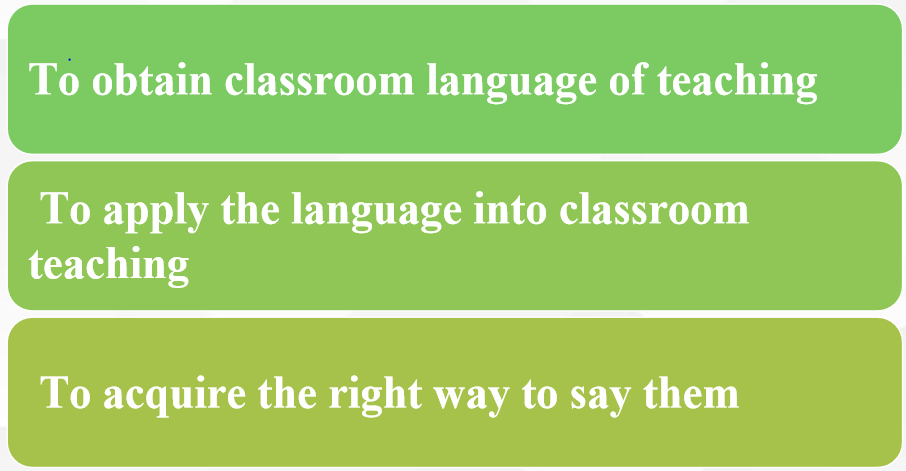
1.单元目标
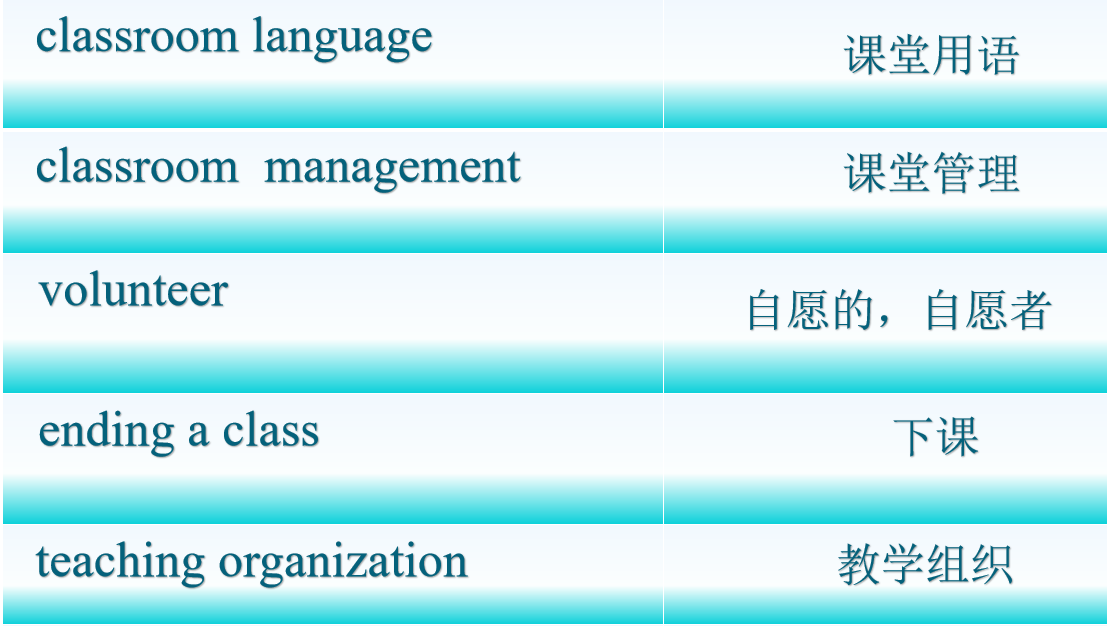
2.核心词汇
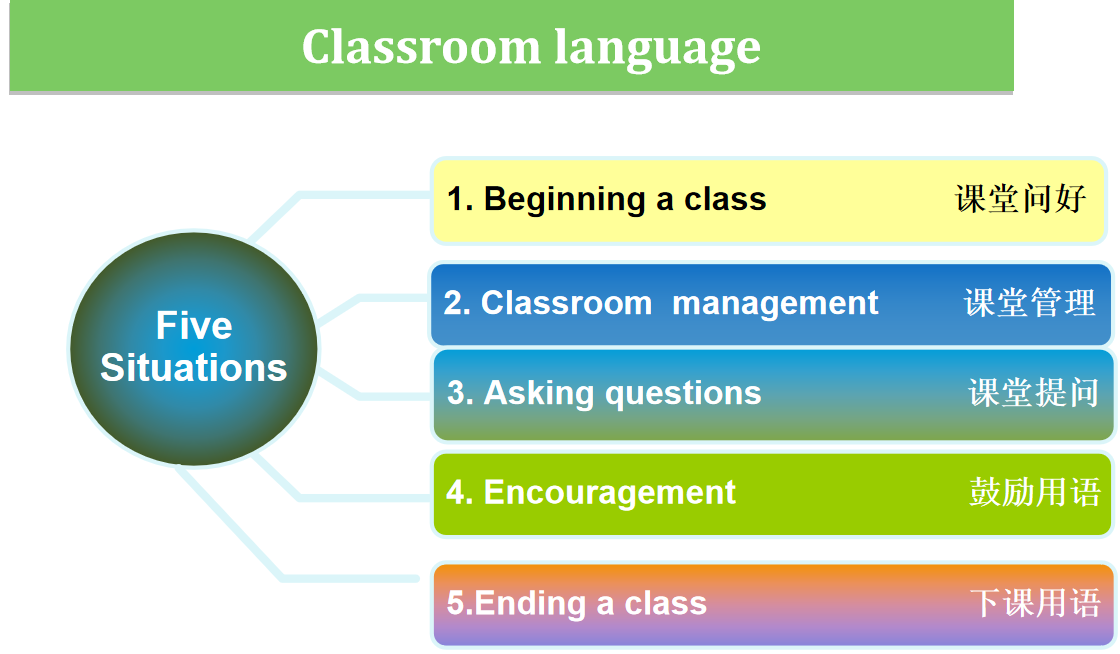
3.重要概念
中国传统文化之墨子的教育思想

墨子是墨家学说的创立者,提出了“兼爱”“非攻”“尚贤”“尚同”“天志”“明鬼”“非命”“非乐”“节葬”“节用”等观点,以兼爱为核心,以节用、尚贤为支点,创立了以几何学、物理学、光学为突出成就的一整套科学理论。墨家在先秦时期影响很大,与儒家并称“显学”。战国时期的百家争鸣,有“非儒即墨”之称。
视频仅用于学习交流
墨子的教育思想是“艰苦实践、服从纪律”。具体为:
1.墨子重视环境和教育对于人性形成的重要作用。
墨子提出了著名的“素丝说”,认为人性如素丝,以素丝和染丝为喻,形象地说明环境、教育对人性形成的重要性。
2、墨子主张以“兼士”作为教育的培养目标,通过他们去实现贤人政治。
墨子认为兼士应该具有知识技能、思维论辩和高尚道德三项要求。其中道德高尚尤为重要。唯有如此,兼士才能以兴天下之利、除天下之害为己任,不分彼此、亲疏、贵贱和贫富。
3、在教育内容方面,墨子除了主张进行政治和道德教育、文史知识教育之外,还特别重视科学技术知识教育和培养思维能力的教育。
前者包括生产和军事科学技术知识教育以及自然科学知识教育,目的在于训练和形成逻辑思维能力,善于与人进行论辩,说服别人,推行自己的政治主张。与儒家主张“六艺”教育相比,这是墨子在教育内容方面的一个重要创造。
4、在教育原则和方法上,墨子不赞同儒家的方法,而是提倡积极主动地去说教。
1.授课视频
优化后视频
2.课后测试
3.教学课件
少儿英语教师课堂用语300句
第一部分 复习热身( Revision and warm-up)
I.课前准备 (Preparation for a class)
1. Clean the blackboard, please.
2. Try to be on time. / Don't be late next time.
3. Go back to your seat, please.
4. Linda, have you collected the students’ homework?
5. Here are your exercise-books. Please hand them out.
6. Monitor, would you please get some chalk for me?
7. I’m sorry I’m late. / Excuse me for coming late.
8. Pass me the ruler and help me with the wall charts, please.
II. 组织上课 (Beginning a class)
9. Are you ready for class?
10.Class begins./ It’s time for class. Let’s start our class/lesson./ Let's get started.
11. Stand up, please! / All rise, please!
III. 问候 (Greeting)
12. Hello. / Good morning / afternoon, class /everyone /everybody /children/boys and girls.
13. Sit down, please./Please be seated.
IV.考勤 (Checking attendance)
14. Who's on duty today?/Who's helping today?
15. Is everyone/everybody here/present?
16. Is anyone /anybody absent?
17. Who's absent/not here/ not at school?/Who's away?
18. Where is he/she? Do you know where he/she is?
V. 自由对话(Free talk)
19. How are you today?
20. Did you have a good weekend?
21. Did you enjoy the holiday?
22. Tell me what you did at the weekend?
23. What day is it today?
24. What's the date today?
25. What's the weather like today? /How’s the weather today?
VI. 课前演讲(Speech)
26. Who’s going to give us a speech today? Who’d like to tell us a story today?
27. You can choose any topic you like.
28. Listen to him carefully then ask and answer questions about his speech/talk.
VII. 复习(Revision)
29. First, let's review the lesson.
30. What did we learn in the last lesson?
31. Who can remember /tell me what we learned in the last lesson?
32. Before the new lesson, let’s review some words and phrases.
33. Take out your exercise-book. Let’s have a dictation about the words.
34. I’ll ask two students to write the answers on the blackboard.
Any volunteer?
35. Who would like to come to the front and write on the blackboard?
36. So much for the dictation. Please hand in your exercise-books.
第二部分 新课 New Lesson
I. 导入(Lead in)
37. Now it’s time to learn the new lesson. Unit 1 Lesson 1.
38. Now we're going to learn something new/ different./Now let's learn
something new.
39. What’s the title of this unit, please?
40. What do you think we’re going to learn from the title?
II. 学习新的词汇和表达方式 (Learning the new words or expressions)
41. Now we’re going to learn some new words and expressions.
42. Have you previewed the new words?
43. What’s the meaning of the word?
44. Who can explain the use of the word to me?
45. (Give me) An example, please? Can you give me an example?
46. OK. Tell me the differences between the two sentences.
47. Can you tell A from B now?
48. Look up the word in the dictionary.
49. Can you make a sentence with this word/phrase.
50.Can you say the sentence/phrase/word in another way?
III. 口语(Speaking)
51. Project your voice so everyone in the room can hear you.
52. Show your usual self when speaking English to your classmates.
53. Give complete sentences.
54. Act in the roles of the two characters in the passage.
55. Why don’t you retell the story in your own words?
56. Shall I give you a clue?
57. Sum it up in a few words.
58. What can you see in the picture?
59. What else? Anything else / more? Any other things?
60. Look at Picture 1, guess what is going on/ has happened?
61. Who can describe all the pictures in detail again?
62. Well, let’s come to the dialogue in Part II.
63. Read the dialogue in pairs, please.
64. Practice the dialogue in pairs then act it out.
65. Now Tom will be A, and the other half will be B.
66. Let’s do a role –play. Who wants to be A?
67. Who wants to act the dialogue out?
68. Make a dialogue using the following expressions.
69. Ask and answer questions about the dialogue.
70. Make a similar dialogue according to your own real life.
71. Complete the dialogue.
IV. 听力(Listening)
72. It is essential to identity who, what, when, where, why and how of an
utterance.
73. Listen until you understand all the details.
74. Guess the implication from the context.
75. This is go give you practice in listening for the general idea.
76. Let me give you some key words (difficult words/ new words).
77. Listen again and pick out words that you don’t know.
78. That seemed a little too fast.
79. Can you explain it in your own words?
80. Jot down the main points while listening.
81. Listen and mark the answer to each question.
82. Now listen to the tape. Before listening, look at the pictures and guess who
can play soccer well.
83. Before listening, read through the questions in the book.
84. Close your books while listening.
85. Let’s check the answers.
86. Listen again, do Exercise 2, please.
87. Listen to the tape again and repeat, then answer more questions.
V. 阅读(Reading)
88. What’s the title of the passage, please?
89. How many paragraphs are there in this article?
90 Skimming---Read fast then tell me the main/ general idea of each paragraph.
91. Now read the text quickly, and find out the answers to the questions.
92. Scanning---Read again carefully, then answer the questions.
93. Read carefully; fill in the blanks according to the passage.
94. Read it in detail /carefully for the second time, then answer the questions on
Page 24 of your workbook.
95. Can you tell me the clue sentence?
96. Now read the text by yourself. If you have any questions, please ask me.
97. Listen and repeat./Listen and try to follow it.
98. Translate this sentence into Chinese. /Put the sentence into Chinese.
99. Who can guess the meaning of the word in the context?
100. Find out the important words and phrases in the paragraph.
101. Find out the difficulties that you don’t understand.
102. What does “them” in Line 2, Paragraph 3 refer to according to the
context?
103. Look at the key words on the blackboard and retell the text.
104.Now who can retell the text according to the table (表格) ?
105. Can you predict a good ending for this passage?
106. Paraphrase the sentence, please.
Who can say it in another/a different way?
107. What do you think of the article? /How do you like the article?
108. What have you learned from the text?
109. What’s your opinion/idea?
VI. 语音(Pronunciation)
110.Who can tell me what letter or letter combination(字母组合)
makes / i:/ sound?
111. Read it correctly. Pay attention to the pronunciation and intonation.
112. Letter “a” here makes an /ei/ sound.
113. Read the sentence with a rising /falling tone/intonation.
114. How many syllables does this word have?
115. Which syllable is stressed?
116. Pronounce the long vowels long enough.
117. Pronounce diphthongs fully.
118. Notice the difference between the two consonants.
VII. 写作(Writing)
119. After learning the text, please rewrite the text within 100 words.
120. Shorten the text in your own words.
121. Look at the pictures and the words given; write a story within 100 words.
122. Write an 80-word passage with the following expressions in ten minutes.
123. Have you finished the writing? Finish up?
124. After learning the text, write a new composition.
125. The title should be written with a capital letter.
126.Always remember to check the punctuation when you check your spelling.
127. A comma (period/ full stop/ semicolon/ colon) is needed here.
128. Begin each paragraph on a new line with an indentation of four spaces.
129. Write neatly and carefully.
130. Don’t write to the very edge (side) of the paper.
131. Don’t always use the same words and phrases in your composition.
132. Look up words where you are not too sure in the process of your writing.
133. Brainstorming before writing is important in generating ideas.
134. This sentence is too long and complicated.
135. Focus on the topic sentence within one paragraph.
136. You can first give the background information, and then present the theme.
137. Organize your thoughts well before you write.
138. You will be a proficient writer if you keep practicing.
Ⅷ. 语法(Grammar)
139. What part of speech is this word in the sentence?
140. Pay attention to the use of form words (function words) in this sentence.
141. Pay special attention to the verbs.
142. Put the attributive phrases after the nouns they modify.
143. Provide the adjective derivative of the word.
144. Replace the nouns with appropriate pronouns.
145. Analyze the grammar of the sentence.
146. What is the subject in the sentence?
147. Think whether it is an object or a subject complement.
148. Invert the sentence.
149. Find out all the general, special, alternative and disjunctive questions.
150. Classify the sentences in the paragraph into dimple, compound and
complex sentences.
151. Transform this attributive clause into a participial phrase.
152. Put this auxiliary verb at the beginning of the emphatic sentence.
153. Render the direct speech in the passage into the reported speech.
154. Let’s look up a new grammar point.
155. Explain the difference between their usages.
第三部分 练习 (Exercises)
156. Let’s go back to the exercises. Please watch the big screen.
157. Look at the exercises on Page 46.
158. Fill in the missing words.
159. Fill in the blanks with proper words.
160. Fill in the blanks with the right form of the words given.
161. Make the two sentences have the same meaning.
162. Correct the mistakes in the following sentences.
163. Make sentences with the following sentence patterns.
164. Make a dialogue according to the passage.
165. Choose the best answer for each blank.
166. Rewrite the sentences according to the requirement.
167. Turn the following sentences into questions according to the questions.
168. Make the following sentences into negative ones.
169. Turn the following sentences into questions then write them in your
exercise book.
170. Fill in the blanks with the right verb forms.
171. Find the word with a different sound. /Find the word which has a different sound from the others.
172. Re-arrange the sentences. / Put the sentences in the right order.
173. Join the two sentences with proper conjunctions.
174. Choose the best answer for the underlined part.
175. Complete the sentences according to the Chinese meaning.
176.Match the words or phrases.
177. Form sentences with the words given.
178. Write questions according to the answers.
179. Write down the short forms of the following.
180. Write down the past and past participle forms of the verbs.
181. Choose the right sound of the underlined word.
182. Put the following sentences into plural forms.
183. Complete the sentences with the past continuous tense.
第四部分 其他课堂活动 (Classroom activities)
I.鼓励 (Encouragement)
184. Who would like to answer this question?
185. Who would like to have a try? Any volunteers?
186. Who knows the answer? Please raise your hand if you know the answer.
187. Just have a try. It doesn’t matter if you make any mistakes.
188. Come on. You can do it.
189. Don’t worry. Take it easy!
190. Don’t be nervous!
191. Be active!
192. Be brave!
193. No hurry/ Take your time.
194. Anything more? Who can say something more about it?
195. Who has a different idea?
196. Use your head.
II.组织课堂,提起注意(Organizing class ,Directing attention)
197. Look here, please.
198. All eyes on me, please! /Look at me, please!
199. Don’t look out of the window.
200. Attention, please.
201. Keep silent.
202. No more talking, please.
203. Stop making noise. Don’t disturb the others.
204. Don’t whisper to each other.
205. Watch carefully, please.
206. Please look at the blackboard/picture/map...
207.Please write neatly.
208. Pay attention to your spelling and pronunciation.
209. Throw the waste paper away.
210. Look at what I'm doing.
211. You may do as I do.
III.发出指令、询问情况 (Issuing a command ,Making inquiries)
212.Let’s start now./Let’s get started.
213. All together, please
214.Let's do it one by one.
215. Whose turn is it?
216. It's your turn.
217. Who’s next?
218. Hands down.
219. Please open your books and turn to Page 1.
220. ( I beg your ) pardon? I didn’t hear you clearly.
221. Please repeat it.
222. ( A little ) Louder, please.
223. Read slowly and clearly. Slow down, please
224. Follow me, please/Read after me, please.
225. Hurry up, please.
226.Go ahead, please.
227. It’s better to say it in English.
228. You may speak Chinese if you can’t say it in English.
229. Tell me the full/short answer, please.
230. Put your things away.
231. Please take out your notebooks/exercise books.
232. Plug in the tape recorder, please.
233.Are you clear? /Do you understand? Do you catch my idea?
234. What do you mean by that?
235. Are you tired? Let’s take a break.
236. Is that correct?
237. Do you know how to correct the mistakes?
238. Are you through? / Have you finished?
239. Do you have any questions?
240. Do you agree with him?
IV. 小组活动及游戏 (Group work and games)
241. Now let’s discuss it in groups.
242. Get into groups. / Let’s practice in groups of three / four. / In groups.
243. Let’s sing a song to relax (our minds).
244. Let’s play a game to relax for a moment.
245. Look at them, their actions and guess what they are doing.
246. Let’s see if you can guess. I’ll give you an example.
247. Work in twos on these passages.
248. If you are left alone, you can join any pair (group).
249. Could I have this group to provide the answer?
250. Who would like to take the role of Anna?
251. Imagine you are the lady who has lost her bag.
252. You can refer to your book when you forget things.
253. Let’s give a big hand to them.
254. Let me show you how it is done.
255. Who hasn’t had a chance yet?
256. Get into five teams of five.
257. For each point you score, you will receive a cross on this chart.
258. Find all the mistakes in each other’s work.
第五部分 评价和小结 ( Evaluation)
259. Good!/Very good./Good job./Good work./Good example/Nice work
260. Excellent./Great!/Well done./Very good./ Wonderful/Fantastic/ Terrific!
261. Exactly/ Perfect
262. I don't think so.
263. You’re nearly right, but you'd better...
264. That's not quite right, any other answers?
265. That's almost right.
266. Not bad. /Sounds good.
267. Not quite right, can anyone help him / her? / Try again.
268. Don't worry about it. / No problem.
269. Who can help him with the question, please?
270. Who can correct the mistakes for him?
271. Who can help him out?
272. Good idea! That makes sense.
273. Who can summarize this lesson?
第六部分 布置作业 (Setting homework)
274. Today’s assignment/ homework.
275. Write each word five times.
276. Memorize these words, important phrases and sentences.
277. Learn these words/these sentences/this text by heart.
278. Preview the next lesson.
279. Finish off the workbook exercises.
280. Review the new vocabulary and structure in this unit.
281. Copy the last part of the text.
282. Recite the first paragraph of the text.
283. Be ready for the test on Friday.
284. Review today’s lesson before doing your homework.
285. Finish this task before our next session.
第七部分 下课 (Dismissing the class)
286. Time is up.
287. The bell is ringing. /That’s the bell.
288. Let's stop here.
289. That's all for today.
290. Class is over.
291.. Goodbye./Bye./See you next time.
第八部分 考试 (Test)
292. Brush up on the lessons before any test.
293. We’ll have a test now.
294. Help me hand out the paper.
295. Pass the extra paper back to the front.
296. Write in pen on the answer sheet.
297. Don’t worry, you still have plenty of time to do your work.
298. Hand in the paper.
299. You must finish it in ten minutes.
300. OK/Well, time is up. Hand in your papers, please.

