目录

  • 1 Nomenclature
    • 1.1 Nomenclature
    • 1.2 Inorganic compounds
    • 1.3 Organic compounds
  • 2 Atom
    • 2.1 Basic Atomic Theory
    • 2.2 Evolution of Atomic Theory
    • 2.3 Atomic Structure and Symbolism
    • 2.4 Isotopes
    • 2.5 Early development of the periodic table of elements
    • 2.6 Organization of the elements
  • 3 Atoms: the quantum world
    • 3.1 Wave Nature of Light
    • 3.2 Quantized Energy and Photons
    • 3.3 the Bohr Model
    • 3.4 Wave Character of Matter
    • 3.5 Atomic Orbitals
    • 3.6 3D Representation of Orbitals
    • 3.7 Electron Spin
    • 3.8 Electron Configurations
  • 4 Molecular Shape and Structure
    • 4.1 VSEPR theory
    • 4.2 Hybridization
    • 4.3 sp3 hybridization
    • 4.4 sp2 hybridization
    • 4.5 sp hybridization
    • 4.6 Other hybridization
    • 4.7 Multiple Bonds
    • 4.8 Molecular Orbitals
    • 4.9 Second-Row Diatomic Molecules
  • 5 Fundamentals of Thermochemistry
    • 5.1 Systems, States and Processes
    • 5.2 Heat as a Mechanism to Transfer Energy
    • 5.3 Work as a Mechanism to Transfer Energy
    • 5.4 Heat Capacity and Calorimetry
    • 5.5 The First Law of Thermodynamics
    • 5.6 Heats of Reactions - ΔU and ΔH
    • 5.7 Indirect Determination of ΔH - Hess's Law
    • 5.8 Standard Enthalpies of Formation
  • 6 Principles of Thermodynamics
    • 6.1 The Nature of Spontaneous Processes
    • 6.2 Entropy and Spontaneity - A Molecular Statistical Interpretation
    • 6.3 Entropy Changes and Spontaneity
    • 6.4 Entropy Changes in Reversible Processes
    • 6.5 Quantum States, Microstates, and Energy Spreading
    • 6.6 The Third Law of Thermodynamics
    • 6.7 Gibbs Energy
  • 7 Chemical equilibrium
    • 7.1 Equilibrium
    • 7.2 Reversible and irreversible reaction
    • 7.3 Chemical equilirbium
    • 7.4 Chemical equilibrium constant, Kc
    • 7.5 Le Chatelier's principle
    • 7.6 RICE table
    • 7.7 Haber process
  • 8 Acid–Base Equilibria
    • 8.1 Classifications of Acids and Bases
    • 8.2 The Brønsted-Lowry Scheme
    • 8.3 Acid and Base Strength
    • 8.4 Buffer Solutions
    • 8.5 Acid-Base Titration Curves
    • 8.6 Polyprotic Acids
    • 8.7 Exact Treatment of Acid-Base Equilibria
    • 8.8 Organic Acids and Bases
  • 9 Kinetics
    • 9.1 Prelude to Kinetics
    • 9.2 Chemical Reaction Rates
    • 9.3 Factors Affecting Reaction Rates
    • 9.4 Rate Laws
    • 9.5 Integrated Rate Laws
    • 9.6 Collision Theory
    • 9.7 Reaction Mechanisms
    • 9.8 Catalysis
VSEPR theory


VSEPR Theory

Valence Shell Electron Pair Repulsion Theory uses the basic idea that electron pairs are mutually repulsed to predict the arrangement of electron pairs around a central atom (an atom that has at least two other atoms bonded directly to it). The key to correctly applying VSEPR Theory is to start with a correct Lewis dot structure. From a correct Lewis dot structure, it is a straightforward process to determine the shape of a molecule or polyatomic ion by determining the arrangement of electron pairs around every central atom in the molecule or polyatomic ion.

The step-by-step process to determine the shape around each central atom is

1. Draw the Lewis dot structure.

2. Apply the following analysis to each separate, central atom (where a central atom is an atom with two or more other atoms bonded directly to it.)

a) Find the number of "things attached" to the central atom, where a "thing attached" is either an atom or a non-bonding electron pair.

(Actually, you are counting the number of hybrid orbitals on the central atom, but that is the next theory to be discussed.)

It is important to remember that you are not counting bonds!

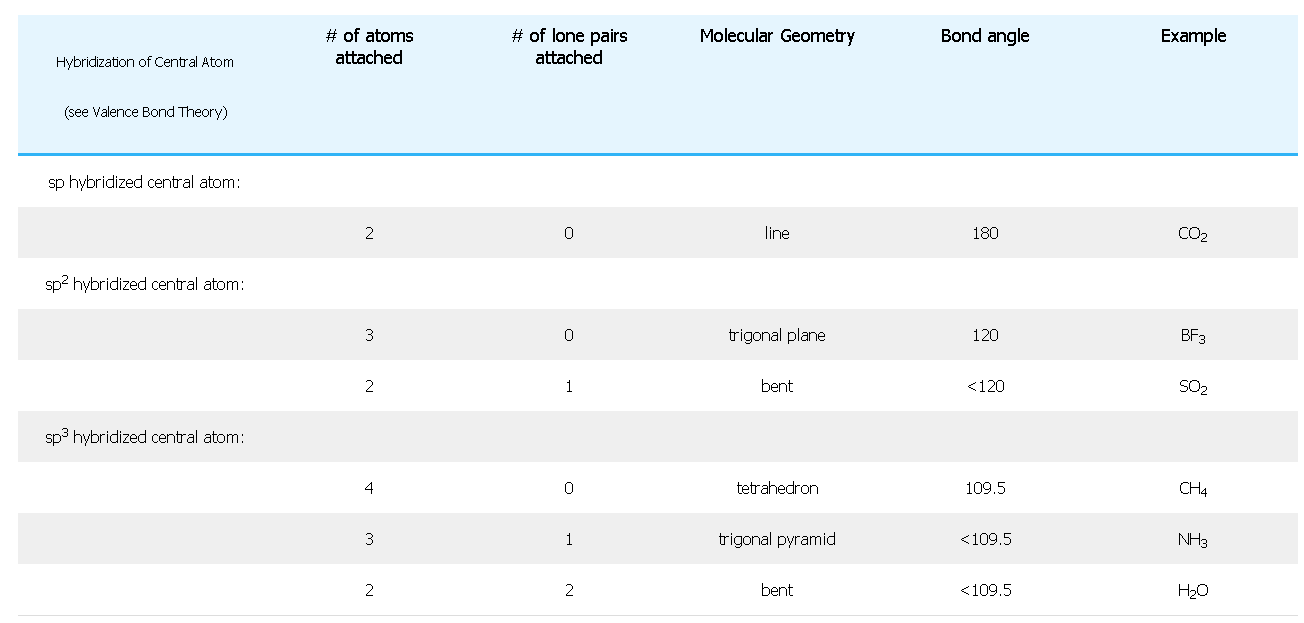
b) Find the Electron Group Arrangement (EGA) in the table below



c) Find the Molecular Geometry (MG) of the particle, determined by counting up the number of atoms and the number of lone pairs and using this table: