目录

  • 1 Nomenclature
    • 1.1 Nomenclature
    • 1.2 Inorganic compounds
    • 1.3 Organic compounds
  • 2 Atom
    • 2.1 Basic Atomic Theory
    • 2.2 Evolution of Atomic Theory
    • 2.3 Atomic Structure and Symbolism
    • 2.4 Isotopes
    • 2.5 Early development of the periodic table of elements
    • 2.6 Organization of the elements
  • 3 Atoms: the quantum world
    • 3.1 Wave Nature of Light
    • 3.2 Quantized Energy and Photons
    • 3.3 the Bohr Model
    • 3.4 Wave Character of Matter
    • 3.5 Atomic Orbitals
    • 3.6 3D Representation of Orbitals
    • 3.7 Electron Spin
    • 3.8 Electron Configurations
  • 4 Molecular Shape and Structure
    • 4.1 VSEPR theory
    • 4.2 Hybridization
    • 4.3 sp3 hybridization
    • 4.4 sp2 hybridization
    • 4.5 sp hybridization
    • 4.6 Other hybridization
    • 4.7 Multiple Bonds
    • 4.8 Molecular Orbitals
    • 4.9 Second-Row Diatomic Molecules
  • 5 Fundamentals of Thermochemistry
    • 5.1 Systems, States and Processes
    • 5.2 Heat as a Mechanism to Transfer Energy
    • 5.3 Work as a Mechanism to Transfer Energy
    • 5.4 Heat Capacity and Calorimetry
    • 5.5 The First Law of Thermodynamics
    • 5.6 Heats of Reactions - ΔU and ΔH
    • 5.7 Indirect Determination of ΔH - Hess's Law
    • 5.8 Standard Enthalpies of Formation
  • 6 Principles of Thermodynamics
    • 6.1 The Nature of Spontaneous Processes
    • 6.2 Entropy and Spontaneity - A Molecular Statistical Interpretation
    • 6.3 Entropy Changes and Spontaneity
    • 6.4 Entropy Changes in Reversible Processes
    • 6.5 Quantum States, Microstates, and Energy Spreading
    • 6.6 The Third Law of Thermodynamics
    • 6.7 Gibbs Energy
  • 7 Chemical equilibrium
    • 7.1 Equilibrium
    • 7.2 Reversible and irreversible reaction
    • 7.3 Chemical equilirbium
    • 7.4 Chemical equilibrium constant, Kc
    • 7.5 Le Chatelier's principle
    • 7.6 RICE table
    • 7.7 Haber process
  • 8 Acid–Base Equilibria
    • 8.1 Classifications of Acids and Bases
    • 8.2 The Brønsted-Lowry Scheme
    • 8.3 Acid and Base Strength
    • 8.4 Buffer Solutions
    • 8.5 Acid-Base Titration Curves
    • 8.6 Polyprotic Acids
    • 8.7 Exact Treatment of Acid-Base Equilibria
    • 8.8 Organic Acids and Bases
  • 9 Kinetics
    • 9.1 Prelude to Kinetics
    • 9.2 Chemical Reaction Rates
    • 9.3 Factors Affecting Reaction Rates
    • 9.4 Rate Laws
    • 9.5 Integrated Rate Laws
    • 9.6 Collision Theory
    • 9.7 Reaction Mechanisms
    • 9.8 Catalysis
Prelude to Kinetics

The lizard in the photograph is not simply enjoying the sunshine or working on its tan. The heat from the sun’s rays is critical to the lizard’s survival. A warm lizard can move faster than a cold one because the chemical reactions that allow its muscles to move occur more rapidly at higher temperatures. In the absence of warmth, the lizard is an easy meal for predators.
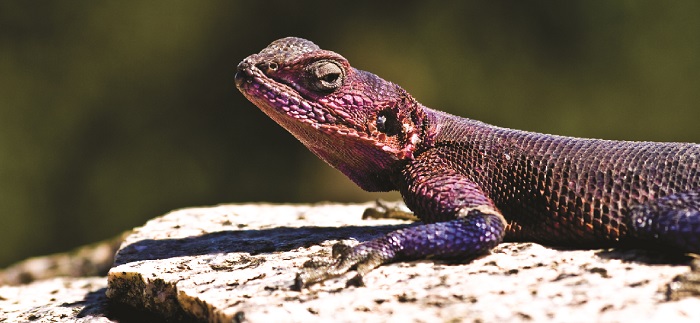

Figure 1: An agama lizard basks in the sun. As its body warms, the chemical reactions of its metabolism speed up.


From baking a cake to determining the useful lifespan of a bridge, rates of chemical reactions play important roles in our understanding of processes that involve chemical changes. When planning to run a chemical reaction, we should ask at least two questions. The first is: “Will the reaction produce the desired products in useful quantities?” The second question is: “How rapidly will the reaction occur?” A reaction that takes 50 years to produce a product is about as useful as one that never gives a product at all. A third question is often asked when investigating reactions in greater detail: “What specific molecular-level processes take place as the reaction occurs?” Knowing the answer to this question is of practical importance when the yield or rate of a reaction needs to be controlled.

The study of chemical kinetics concerns the second and third questions—that is, the rate at which a reaction yields products and the molecular-scale means by which a reaction occurs. In this chapter, we will examine the factors that influence the rates of chemical reactions, the mechanisms by which reactions proceed, and the quantitative techniques used to determine and describe the rate at which reactions occur.