The rates at which reactants are consumed and products are formed during chemical reactions vary greatly. We can identify five factors that affect the rates of chemical reactions: the chemical nature of the reacting substances, the state of subdivision (one large lump versus many small particles) of the reactants, the temperature of the reactants, the concentration of the reactants, and the presence of a catalyst.
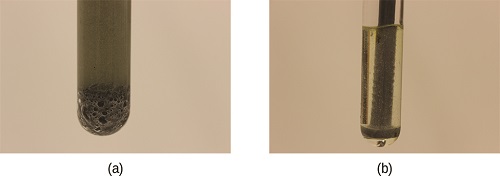
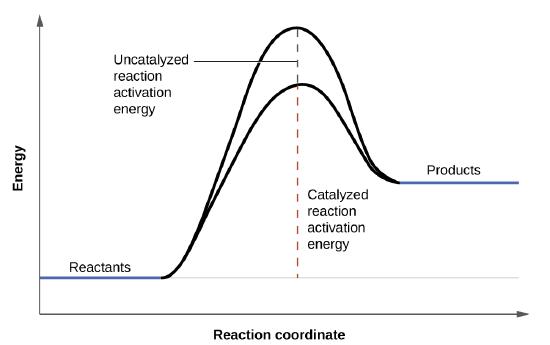
The rate of a reaction depends on the nature of the participating substances. Reactions that appear similar may have different rates under the same conditions, depending on the identity of the reactants. For example, when small pieces of the metals iron and sodium are exposed to air, the sodium reacts completely with air overnight, whereas the iron is barely affected. The active metals calcium and sodium both react with water to form hydrogen gas and a base. Yet calcium reacts at a moderate rate, whereas sodium reacts so rapidly that the reaction is almost explosive. Except for substances in the gaseous state or in solution, reactions occur at the boundary, or interface, between two phases. Hence, the rate of a reaction between two phases depends to a great extent on the surface contact between them. A finely divided solid has more surface area available for reaction than does one large piece of the same substance. Thus a liquid will react more rapidly with a finely divided solid than with a large piece of the same solid. For example, large pieces of iron react slowly with acids; finely divided iron reacts much more rapidly (Figure ). Large pieces of wood smolder, smaller pieces burn rapidly, and saw dust burns explosively. Chemical reactions typically occur faster at higher temperatures. Food can spoil quickly when left on the kitchen counter. However, the lower temperature inside of a refrigerator slows that process so that the same food remains fresh for days. We use a burner or a hot plate in the laboratory to increase the speed of reactions that proceed slowly at ordinary temperatures. In many cases, an increase in temperature of only 10 °C will approximately double the rate of a reaction in a homogeneous system. The rates of many reactions depend on the concentrations of the reactants. Rates usually increase when the concentration of one or more of the reactants increases. For example, calcium carbonate () deteriorates as a result of its reaction with the pollutant sulfur dioxide. The rate of this reaction depends on the amount of sulfur dioxide in the air (Figure ). As an acidic oxide, sulfur dioxide combines with water vapor in the air to produce sulfurous acid in the following reaction: Calcium carbonate reacts with sulfurous acid as follows: In a polluted atmosphere where the concentration of sulfur dioxide is high, calcium carbonate deteriorates more rapidly than in less polluted air. Similarly, phosphorus burns much more rapidly in an atmosphere of pure oxygen than in air, which is only about 20% oxygen. Chemical reactions occur when molecules collide with each other and undergo a chemical transformation. Before physically performing a reaction in a laboratory, scientists can use molecular modeling simulations to predict how the parameters discussed earlier will influence the rate of a reaction. Use the PhET Reactions & Rates interactive to explore how temperature, concentration, and the nature of the reactants affect reaction rates. The rate of a chemical reaction is affected by several parameters. Reactions involving two phases proceed more rapidly when there is greater surface area contact. If temperature or reactant concentration is increased, the rate of a given reaction generally increases as well. A catalyst can increase the rate of a reaction by providing an alternative pathway that causes the activation energy of the reaction to decrease.The Chemical Nature of the Reacting Substances
The State of Subdivision of the Reactants
Temperature of the Reactants
Concentrations of the Reactants



Summary

