-
1 课堂实录视频
-
2 Introduction
-
3 Unit 1 Language and Language Learning
-
3.1 How do we learn language
-
3.2 Views on language
-
3.3 Views on language learning and learning in general
-
3.4 What makes a good language teacher?
-
3.5 How can one become a good language teacher?
-
3.6 An overview of the book
-
4 Unit 2 Communicative Principles and Task-based Language Teaching
-
4.1 Language use in real life vs. traditional pedagogy
-
4.2 What is communicative competence?
-
4.3 Implications for teaching and learning
-
4.4 Principles of Communicative Language Teaching (CLT)
-
4.5 CLT and the teaching of language skills
-
4.6 Main features of communicative activities
-
4.7 Task-based Language Teaching (TBLT)
-
4.8 PPP and Task-based Language Teaching
-
4.9 How to design tasks?
-
4.10 Appropriateness of CLT and TBLT in the Chinese context
-
4.11 Conclusion
-
5 Unit 3 The National English Curriculum
-
5.1 A brief history of foreign language teaching in China
-
5.2 Designing principles for the National English Curriculum
-
5.3 Goals and objectives of English language teaching
-
5.4 Design of the National English Curriculum
-
5.5 Performance standards for different levels of competence
-
5.6 Challenges facing English language teachers
-
5.7 Conclusion
-
6 Unit 4 Lesson Planning
-
6.1 Why is lesson planning important?
-
6.2 Principles for good lesson planning
-
6.3 Macro planning vs.micro planning
-
6.4 Components of a lesson plan
-
6.5 Sample lesson plans
-
6.6 Conclusion
-
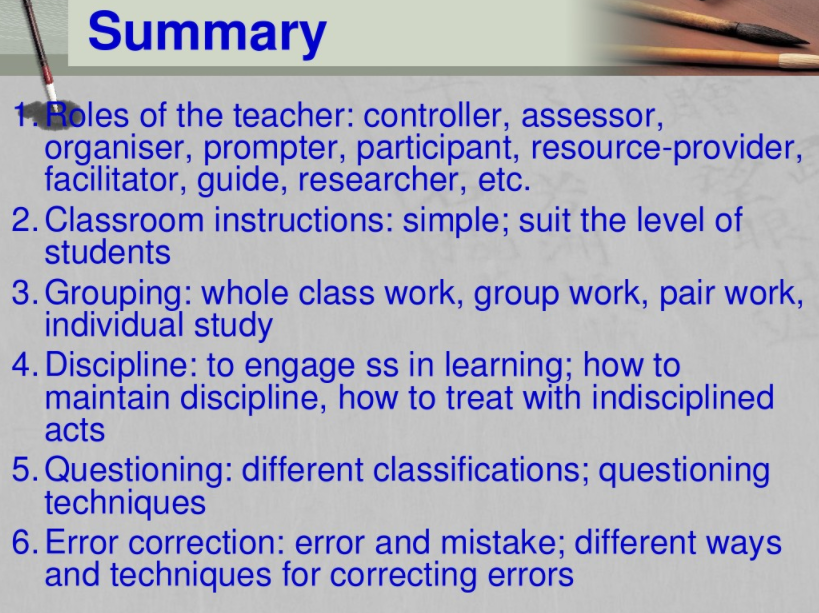
7 Unit 5 Classroom Management
-
7.1 The role of the teacher
-
7.2 Classroom instructions
-
7.3 Student grouping
-
7.4 Discipline in the language classroom
-
7.5 Questioning in the classroom
-
7.6 Dealing with errors
-
7.7 Conclusion
-
8 Unit 6 Teaching Pronunciation
-
8.1 The role of pronunciation
-
8.2 The goal of teaching pronunciation
-
8.3 Aspects of pronunciation
-
8.4 Practising sounds
-
8.5 Practising stress and intonation
-
8.6 Conclusion
-
8.7 Student video
-
9 Unit 7 Teaching Grammar
-
10 Unit 8 Teaching Vocabulary
-
10.1 Understanding vocabulary and vocabulary learning
-
10.2 What does knowing a word involve?
-
10.3 Ways of presenting vocabulary
-
10.4 Ways of consolidating vocabulary
-
10.5 Developing vocabulary learning strategies
-
10.6 Conclusion
-
10.7 Student video
-
11 Unit 9 Teaching Listening
-
11.1 Why does listening seem so difficult?
-
11.2 What do we listen to in everyday life?
-
11.3 Characteristics of the listening process
-
11.4 Principles and models for teaching listening
-
11.5 Pre-listening activities
-
11.6 While-listening activities
-
11.7 Post-listening activities
-
11.8 Conclusion
-
11.9 Student video
-
12 Unit 10 Teaching Speaking
-
12.1 Differences between spoken and written language
-
12.2 Principles for teaching speaking
-
12.3 Designing speaking tasks
-
12.4 Types of speaking tasks
-
12.5 Organising speaking tasks
-
12.6 Conclusion
-
12.7 Student video
-
13 Unit 11 Teaching Reading
-
13.1 Reflecing on your own reading experiences
-
13.2 How do we read?
-
13.3 What do we read?
-
13.4 Stragegies involved in reading comprehension
-
13.5 The role of vocabulary in reading
-
13.6 Principles and models for teaching reading
-
13.7 Pre-reading activities
-
13.8 While-reading activities
-
13.9 Post-reading activities
-
13.10 Conclusion
-
13.11 Student video
-
14 Unit 12 Teaching Writing
-
14.1 What, why and how do we write?
-
14.2 A communicative approach to writing
-
14.3 Problems in writing tasks
-
14.4 A process approach to writing
-
14.5 Motivating students to writing
-
14.6 Designing writing tasks
-
14.7 Using the internet to promote process writing
-
14.8 Conclusion
-
14.9 Student video
-
15 Unit 13 Integrated Skills
-
15.1 Why should we integrate �the four skills?
-
15.2 How can we integrate the four skills?
-
15.3 What are the implications for teaching?
-
15.4 What the limitations of integrating the four skills?
-
15.5 Conclusion
-
15.6 Quiz 14
-
16 Unit 14 Moral Learning
-
16.1 Moral learning and English
-
16.2 Activities for moral learning
-
16.3 The roles of the teacher
-
16.4 The roles of the school
-
16.5 Conclusion
-
16.6 Quiz 15
-
17 Unit 15 Assessment in Language Teaching
-
17.1 Understanding assessment
-
17.2 Assessment purposes
-
17.3 Methods for assessment
-
17.4 Criteria for assessment
-
17.5 Assessment principles
-
17.6 Tests in assessment
-
17.7 Conclusion
-
17.8 Quiz 16
-
18 Unit 16 Learner Differences and Learner Training
-
18.1 Understanding learner differences
-
18.2 Learner training in language teaching
-
18.3 Contents and procedures for learner training
-
18.4 Help learners to become more autonomou
-
18.5 Conclusion
-
18.6 Quiz 17
-
19 Unit 17 Using and Creating Resources
-
19.1 What resources are available for teaching?
-
19.2 Create one’s own resources
-
19.3 Exploring hidden resources
-
19.4 useful websites available for teaching
-
19.5 Conclusion
-
19.6 Quiz 18
-
20 Unit 18 Evaluating and Adapting Textbooks
-
21 综合技能训练
-
21.1 优秀中学教学视频
-
21.2 优秀教学设计
-
21.3 优秀PPT课件
-
22 班主任工作技能
-
22.1 班主任工作常规
-
22.2 班级管理措施
-
22.3 班主任寄语和评语
-
22.4 班主任工作反思
-
22.5 主题班会设计
-
22.6 案例分析
-
22.7 优秀教育工作者先进事迹
-
22.8 德育教育