会计英语

张念念

目录

  • 1 Introduction to Accounting
    • 1.1 What is Accounting
    • 1.2 The History and Development of Accounting
    • 1.3 The Role of Accounting
    • 1.4 The Qualitative Characteristics of Financial Information
    • 1.5 Accounting Elements and Accounting Equation
  • 2 Basic Accounting Standards
    • 2.1 Accounting Underlying Assumptions
    • 2.2 Accounting Basis
    • 2.3 Accounting Principles
  • 3 Recording Transactions
    • 3.1 Types of Transactions
    • 3.2 Source Documents
    • 3.3 Accounting Cycle
    • 3.4 The Ledger Accounts
    • 3.5 Chart of Accounts
    • 3.6 Double-Entry Accounting
    • 3.7 Recording Transactions in a Journal
    • 3.8 Posting from Journal to Ledger
    • 3.9 Trial Balance
    • 3.10 Correcting Errors
  • 4 Current and Non-current Asset
    • 4.1 Basic Concepts of Asset
    • 4.2 Current Asset
    • 4.3 Non-current Asset
  • 5 Current and Non-current Liability
    • 5.1 Basic Concepts of Liability
    • 5.2 Current Liability
    • 5.3 Non-current Liability
  • 6 Owner's Equity
    • 6.1 Forms of Business Organization
    • 6.2 Basic Concepts of Stock
    • 6.3 Ordinary Shares and Preference Shares
    • 6.4 Dividend
    • 6.5 Owner's Equity
  • 7 Revenue and Expense
    • 7.1 Revenue
    • 7.2 Revenue from Sales
    • 7.3 Common Types of Transaction
    • 7.4 Expense
  • 8 Basic Financial Statements
    • 8.1 Statement of Financial Position
    • 8.2 Income Statement
    • 8.3 Statement of Cash Flow
  • 9 Financial Management
    • 9.1 Working Captial Management
    • 9.2 Investment Appraisal
    • 9.3 Business Finance
  • 10 Audit and Assurance
    • 10.1 Internal Control
    • 10.2 Substantive Procedure
    • 10.3 Review and Reporting
Double-Entry Accounting

3.6 Double-Entry Accounting

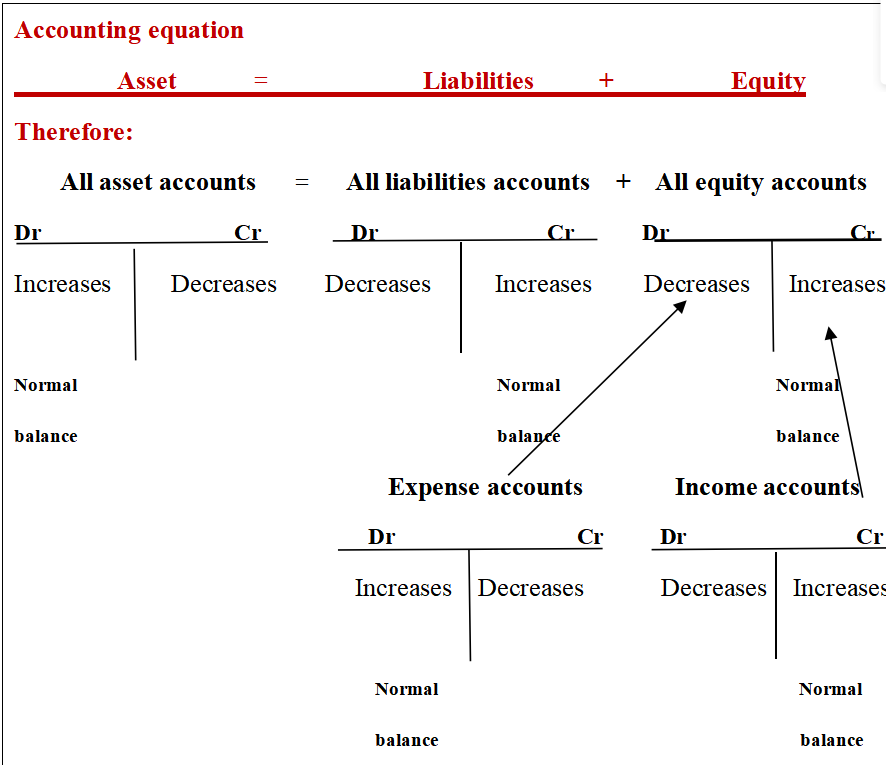
At least two accounts are affected by each transaction, hence the system is referred to as double-entry accounting.

1. Accounts: Balance Sheet

                  Asset          =

Debit to increase

Credit to decrease


Normal Balance


  Liabilities                         +                               Equity

Debit to 

decrease

Credit to increase


Debit to decrease

Credit to increase


             Normal Balance                                    Normal Balance

Not only must the accounting equation be in balance, but the sum of the debit balances must equal the sum of the credit balances. 

2. Accounts: Income Statement

Income (Incl. Revenue)                          Expense

Debit to 

decrease

Credit to 

increase


Debit to increase

Credit to decrease