
会计英语

张念念

目录

  • 1 Introduction to Accounting
    • 1.1 What is Accounting
    • 1.2 The History and Development of Accounting
    • 1.3 The Role of Accounting
    • 1.4 The Qualitative Characteristics of Financial Information
    • 1.5 Accounting Elements and Accounting Equation
  • 2 Basic Accounting Standards
    • 2.1 Accounting Underlying Assumptions
    • 2.2 Accounting Basis
    • 2.3 Accounting Principles
  • 3 Recording Transactions
    • 3.1 Types of Transactions
    • 3.2 Source Documents
    • 3.3 Accounting Cycle
    • 3.4 The Ledger Accounts
    • 3.5 Chart of Accounts
    • 3.6 Double-Entry Accounting
    • 3.7 Recording Transactions in a Journal
    • 3.8 Posting from Journal to Ledger
    • 3.9 Trial Balance
    • 3.10 Correcting Errors
  • 4 Current and Non-current Asset
    • 4.1 Basic Concepts of Asset
    • 4.2 Current Asset
    • 4.3 Non-current Asset
  • 5 Current and Non-current Liability
    • 5.1 Basic Concepts of Liability
    • 5.2 Current Liability
    • 5.3 Non-current Liability
  • 6 Owner's Equity
    • 6.1 Forms of Business Organization
    • 6.2 Basic Concepts of Stock
    • 6.3 Ordinary Shares and Preference Shares
    • 6.4 Dividend
    • 6.5 Owner's Equity
  • 7 Revenue and Expense
    • 7.1 Revenue
    • 7.2 Revenue from Sales
    • 7.3 Common Types of Transaction
    • 7.4 Expense
  • 8 Basic Financial Statements
    • 8.1 Statement of Financial Position
    • 8.2 Income Statement
    • 8.3 Statement of Cash Flow
  • 9 Financial Management
    • 9.1 Working Captial Management
    • 9.2 Investment Appraisal
    • 9.3 Business Finance
  • 10 Audit and Assurance
    • 10.1 Internal Control
    • 10.2 Substantive Procedure
    • 10.3 Review and Reporting
Recording Transactions in a Journal


3.8 Recording Transactions in a Journal

Recording transactions in a journal is called entering or journalising, and each transaction recorded is a separate journal entry.A journal entry involving more than two accounts is called a compound journal entry.
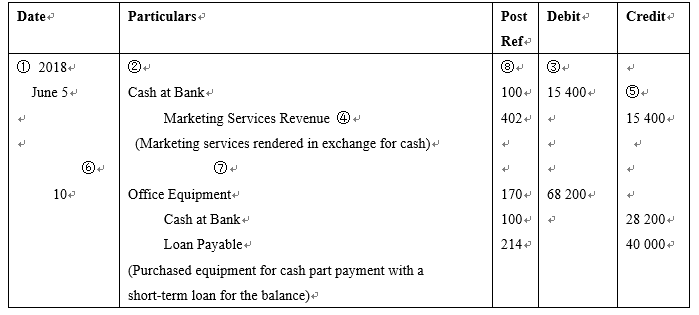
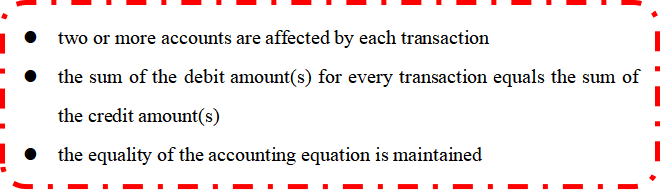
The principles of double-entry accounting are observed for each transaction 
 The process for journalising transactions:

1. The date of each transaction is entered in the date column.

2. The name of the account(s) to be debited is entered against the left margin of the particulars column.

3. The amount to be debited to each account is entered in the debit amount column on the same line as the account name.

4. The name of the account(s) to be credited is entered on the line immediately below the account(s) to be debited and is indented to distinguish the account(s) credited from the account(s) debited.

5. The amount to be credited to each account is entered in the credit amount column on the same line as the account name.

6. A brief explanation of the transaction is entered.

7. A single line is usually left blank between each journal entry.

8. The posting reference column is left blank until the account is posted to the ledger (see below).