
会计英语

张念念

目录

  • 1 Introduction to Accounting
    • 1.1 What is Accounting
    • 1.2 The History and Development of Accounting
    • 1.3 The Role of Accounting
    • 1.4 The Qualitative Characteristics of Financial Information
    • 1.5 Accounting Elements and Accounting Equation
  • 2 Basic Accounting Standards
    • 2.1 Accounting Underlying Assumptions
    • 2.2 Accounting Basis
    • 2.3 Accounting Principles
  • 3 Recording Transactions
    • 3.1 Types of Transactions
    • 3.2 Source Documents
    • 3.3 Accounting Cycle
    • 3.4 The Ledger Accounts
    • 3.5 Chart of Accounts
    • 3.6 Double-Entry Accounting
    • 3.7 Recording Transactions in a Journal
    • 3.8 Posting from Journal to Ledger
    • 3.9 Trial Balance
    • 3.10 Correcting Errors
  • 4 Current and Non-current Asset
    • 4.1 Basic Concepts of Asset
    • 4.2 Current Asset
    • 4.3 Non-current Asset
  • 5 Current and Non-current Liability
    • 5.1 Basic Concepts of Liability
    • 5.2 Current Liability
    • 5.3 Non-current Liability
  • 6 Owner's Equity
    • 6.1 Forms of Business Organization
    • 6.2 Basic Concepts of Stock
    • 6.3 Ordinary Shares and Preference Shares
    • 6.4 Dividend
    • 6.5 Owner's Equity
  • 7 Revenue and Expense
    • 7.1 Revenue
    • 7.2 Revenue from Sales
    • 7.3 Common Types of Transaction
    • 7.4 Expense
  • 8 Basic Financial Statements
    • 8.1 Statement of Financial Position
    • 8.2 Income Statement
    • 8.3 Statement of Cash Flow
  • 9 Financial Management
    • 9.1 Working Captial Management
    • 9.2 Investment Appraisal
    • 9.3 Business Finance
  • 10 Audit and Assurance
    • 10.1 Internal Control
    • 10.2 Substantive Procedure
    • 10.3 Review and Reporting
Trial Balance

3.9 Trial Balance

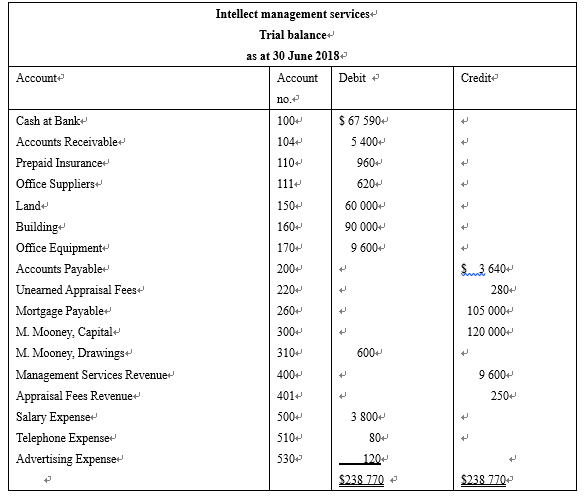
The equality of debits and credits posted to the ledger accounts is verified by preparing a trial balance- a list of all of the accounts in the order in which they appear in the general ledger with their current balances.

A trial balance that does not balance is a clear indication of one or more in the accounts, or an error in preparing the trial balance.

Although there is no one correct procedure for locating all types of errors, the following systematic approach will be helpful.

1. Check the accuracy of the trial balance totals by adding the columns again.

2. Calculate the difference between the totals.

3. Compare the balances listed in the trial balance with the ledger accounts to verify that all account balances were included and copied correctly.

4. Recalculate the account balances.

5. Verify that the debits equal the credits for each entry in the journal.

6. Trace the entries as recorded in the journal to the ledger accounts, and place a small tick by each account in the journal and ledger as each posting is verified.