
-
1 Reading 1
-
2 Reading 2
BACKGROUND ARTICLE 1
Google is developing some new software for translating text on computers. Google also has a voice-recognition system that enables the users to conduct web searchers by using voices instead of typing words in. The new technology has transformed communication among speakers of many different languages in the world.
WHO NEEDS TRANSLATORS?
 Google is developing software for the first phone capable of translating foreign languages almost instantly. By building on existing technologies in voice recognition and automatic translation, Google hopes to have a basic system ready within a couple of years. If it works, it could eventually transform communication among speakers of the world’s 6,000-plus languages.
The company has already created an automatic system for translating text on computers, which is being honed by scanning millions of multilingual websites and documents. So far, it covers 52 languages. Google also has a voice-recognition system that enables phone users to conduct web searches by speaking commands into their phones rather than typing them in.
Now it is working on combining the two technologies to produce software capable of understanding a caller’s voice and translating it into a synthetic equivalent in a foreign language. Like a professional human interpreter, the phone would analyse ‘packages’ of speech, listening to the speaker until it understands the full meaning of words and phrases, before attempting translation.
BACKGROUND ARTICLE 2
Anna Haupt and Terese Alstin came up with the concept for their helmet while studying industrial design at Lund University in Sweden. They were inspired by survey data showing people wanted a better looking or, ideally, invisible helmet that would still keep them safe. The designer, named ‘Hövding’ was a revolutionary solution. Besides looking good, cyclists who wear the Hövding helmet enjoy better protection of their head and neck because it absorbs shock three times better than standard bike helmets currently on market. The invention also holds potential to protect people practicing other sports and even those who have epilepsy.
SAFER CYCLING ARTICLE 2
Swedish designers have created a cycling ‘collar’that is worn around the neck with an airbag hidden inside. When sensors in the device determine a crash has happened, an airbag instantly inflates around the cyclist's head to form a helmet.
The invention was presented today in Stockholm. It will go on sale in Sweden early next year for about £50. The designers have spent six years developing it. Terese Alstin, one of the inventors, said, ‘The protection should include keeping the sense of freedom and not ruining your hairstyle.’
The device has been improved by recreating hundreds of accidents using crash-test dummies and real riders. ‘We have developed a unique, patented, mathematical method to distinguish these movement patterns,’ say the inventors. A small helium gas cylinder inflates the airbag in 0.1 seconds and is designed to let cyclists see at all times.
The airbag stays inflated for several seconds. It is powered by a rechargable battery. Co-collar inventor Anna Haupt said, ‘The shell of the collar is removable and available in many different styles and fabrics, and will be launched in new fashion collections.’
BACKGROUND ARTICLE 3
TG-Gold-Super-Markt installed the first gold-to-go vending machine in Germany's Frankfurt Airport. The machines are not just shiny gold on the outside, they actually vend gold in the form of 1 gram, 5 gram, 10 gram and 1 ounce bars, and also Krugerrand, Kangaroo and Maple Leaf gold coins (individual machines may have custom settings). The bars and coins come in snazzy presentation cases but even so, they're said to cost about 20 percent less than what a German bank or other financial institution would charge. However, the gold-to-go machine in the lobby of Abu Dhabi's Emirates Palace hotel differs from the original vending machine set up at the Frankfurt Airport. It dispenses gold bars of only 1 and 10 grams, plus a series of gold coins displaying custom engraved designs.
Going for Gold ARTICLE 3
Apart from being gold-plated – and the fact that they are bulletproof – they seem much like any other vending machine. But instead of chocolate bars, a network of “gold-to-go” machines dispenses 24-carat bullion in a smart presentation box.
Originally designed as a marketing device for an online gold-trading business, the machines have become such a success that their inventor plans to build a global network, installing them everywhere from fitness centres to cruise ships. Thomas Geissler, the German businessman behind the machines, said their unexpected success was the result of a recent interest in gold. “Our customers are those who are catching on to the idea that gold is a safe investment at a time of financial instability,” he said.
Since the first machine was installed in May, in the lobby of Abu Dhabi’s Emirates Palace hotel, 20 gold-to-go machines have appeared across Europe. Germany already has eight. Next month, the first machines will open in the United States – in Las Vegas and Florida. The company claims its gold is cheaper than that available from the banks, largely because its overheads are lower, and that unlike at a bank, the machine gold is available immediately.
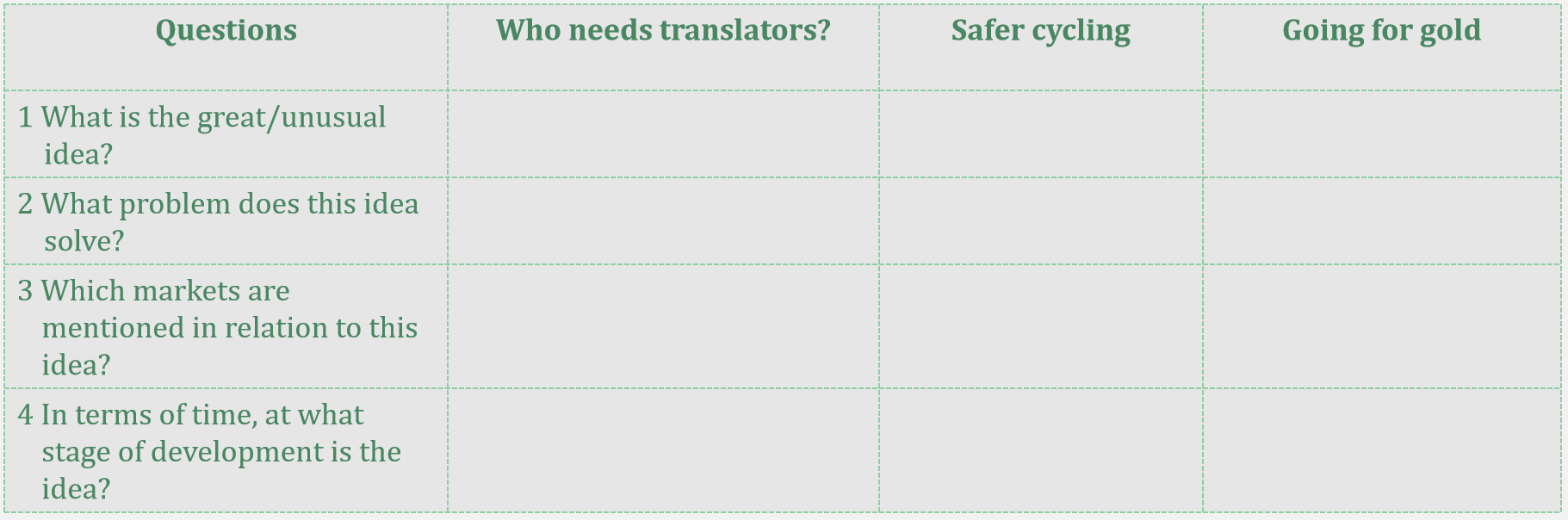
Make quick notes in answer to the questions below about your article.
Discuss these questions in pairs.
1 Which of the ideas do you find the most interesting? Why?
2 Which idea do you think will be the most profitable?
3 Which idea will reach the most markets?
4 Can you think of any problems any of the ideas might have?
[WORDS & EXPRESSIONS]
airbag
n. a safety device in a car which automatically fills with air if the car crashes and is designed to protect the people in the car when they are thrown forward in the crash 安全气囊
e.g. All models have front, side and curtain airbags.
bullion
n. gold or silver, usually in the form of bars 金条,银条
e.g. Now is a good time to reduce holdings in bullion and buy some gold miners.
cylinder
n. a gas container with flat circular ends and long straight sides in which gas is kept under pressure 气缸
e.g. When he returned he found a bicycle with a gas cylinder strapped to it left next to his car.
dispense
v. to obtain a product by getting it out of a machine(机器)售出(商品)
e.g. The bank is also experimenting with a cash machine that will dispense US dollar and euro bills.
dummy
n. a model of a person 人体模型
e.g. He had this dummy he could use to go left or right.
equivalent
n. the same use, function, size, or value in a different place, time, or system等效,等价物
e.g. The equivalent of the Red Cross emblem is the Red Crescent in Muslim countries.
helium
n. a very light gas that is colorless and has no smell 氦气
e.g. Everyone is familiar with helium gas.
helmet
n. a hat made of a strong material which you wear to protect your head 头盔
e.g. She was not wearing a helmet.
hone
v. to develop and improve (a quality or ability) 提高
e.g. You can always book another class to hone your skills.
inflate
v. to become bigger as something is filled with air or gas 充气
e.g. If he could inflate the raft there in some shelter it might survive long enough to load.
instantly
adv. immediately 立即,马上
e.g. Familiar in the sense that his features were instantly recognisable.
multilingual
adj. of involving several different languages 使用多种语言的
e.g. He recruited two multilingual engineers.
patent
v. to have an official right to be the only person or company allowed to make or sell a new product for a certain period of time 取得专利
e.g. The invention has been patented by the university.
patented
adj. of having an official right to be the only person or company allowed to sell a new product for a certain period of time 取得专利的
e.g. It is a patented process for disinfecting liquids.
scan
v. to look at something carefully, usually because you are looking for something or someone 仔细查看
e.g. She scanned the advertisement pages of the newspapers.
synthetic
adj. artificial 人造的
e.g. This is the first synthetic cell.
type
v. to use a computer keyboard, typewriter or word processor to write it 打字
e.g. I can type your essays for you.
vend
v. sell 售卖
e.g. It is still prepared to sanction a sale of vending, but at the right price.

