Quotation
Marketing is the art of making something better than it really is.
——Suso Banderas (pen name of Mark Krenz ), American writer
‘Business has only two functions - Marketing and innovation.'
——Peter F. Drucker (1909-2005) Management expert
4Ps
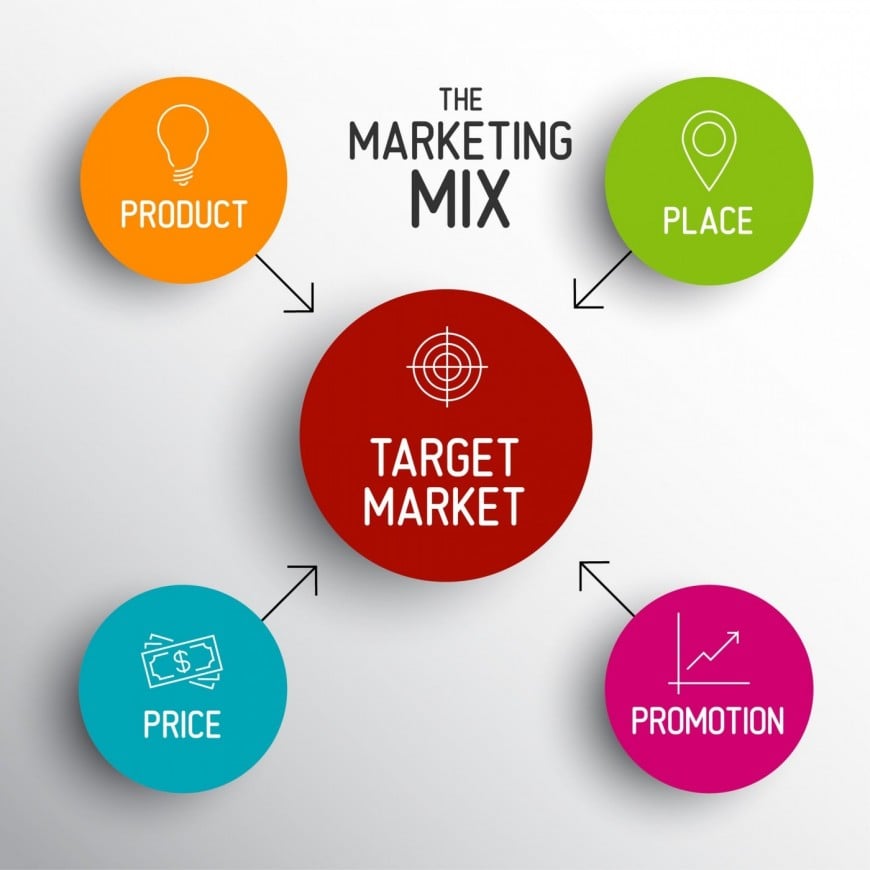
The four Ps’ form the basis of the ‘marketing mix’. If you want to market a product successfully, you need to get this mix right.
Match the Ps 1–4 to their definitions a)–d).
Listen to four consumers talking about different products. Decide which of the four Ps each speaker is discussing: product, price, promotion or place.
What is the 4P Marketing Matrix?
The principle of the 4P Matrix is that marketing decisions usually fall into four controllable categories: product, place, price and promotion. Carefully positioning your product in each category will generate the greatest response from your target market.
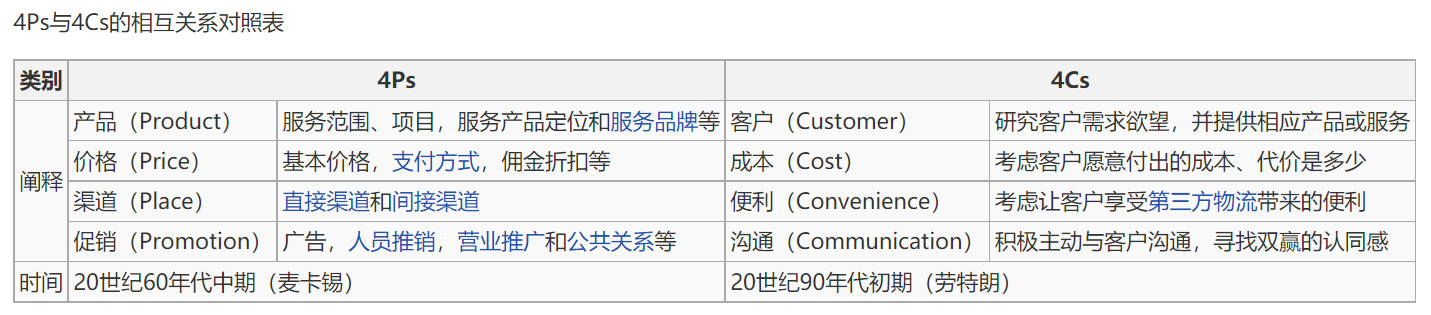
The 4P Matrix dates back to the 1960s, and is arguably the most frequently used marketing matrix because it’s simple and it works. The 4P matrix can help you define your marketing options, whether you’re planning to launch a new product or you’re evaluating an existing one.
As a small business owner, learning to use the 4Ps successfully gives you an advantage over the competition and that’s good for your bottom line.
1. Product
Considerations include: benefits, features and product interaction
From the most basic to extremely detailed, there are a number of questions to ask when making product marketing decisions. Here are a few of the most important:
What need does your product satisfy? What problem does it solve, or what challenge does it help the customer overcome? In other words, what will the customer gain by using your product? How will it benefit him or her?
What features does the product have that help it meet the needs of your customer?
What is your product’s competitive advantage? How is your product different from your competitors? Why should the customer buy your product instead of your competition’s?
Let others interact with your product, and then ask if it includes any features that aren’t really useful. Also, ask if there are features the product should offer, but doesn’t.
2. Place
Considerations include: location, how to get product into the market and distribution
Questions to ask about place range from how it will be distributed to what market it will be found in. Here are a few questions to get you started thinking about place:
Where will your potential buyer look for your product? Will it be found in a brick and mortar store, in a catalog, only on the web or a combination of one or more locations?
If your product will be sold in a brick and mortar store, what characteristic will the store have? For example will it be sold in a boutique, or sold through a discount store? Will it be found in a house wares store, grocery store, children’s store, etc?
What is your plan for getting your product into the market.
Will you sell directly to your customers or use a distributor or a sales team?
3. Price
Considerations include: price strategy, discounts and profit margin
When considering what price to set your product at, remember that your customer must perceive value in your product and that means you won’t win customers on price alone. Consider these questions when trying to set your product price:
What amount does your competition sell the product for? Are you able to set and maintain a competitive market price? How will your price compare to your competitors?
Will you offer discounts or buying advantages? Will you offer a loyalty program or rewards program?
Will your product be offered at more than one price point? If so, why?
What is the lowest price you can set for your product and still maintain the profit margin you need?
4. Promotion
Considerations include: marketing channels, marketing strategy and seasonality
Even the best products won’t sell if your customer doesn’t know about them. When considering how you will promote your product, ask yourself these important questions:
By what means will you get your marketing message to your potential customer? For example, will you use direct mail, billboards, the web, social media, etc?
When will you start promoting your product and what is your reason for promoting it at that time? Will you promote the product two months before its release? Six months prior?
Is the product seasonal? If so, how will that impact when, where and how you promote it?
Use the 4P Matrix to analyze your current products as well as any new products you're developing. Make sure to follow up with products periodically to make sure it's still on target with your demographic. The 4Ps model is just one of several marketing mixes that have emerged over the last several decades, but it’s simple yet comprehensive framework makes it one of the very best.
Ref: What is the 4P Marketing Matrix? | Business.org


