目录

  • 1 Culture
    • 1.1 Course introduction
    • 1.2 Case Study
    • 1.3 Culture
      • 1.3.1 Cultural Confidence
    • 1.4 Differences between Chinese culture and western culture
  • 2 Communication
    • 2.1 Comunication
      • 2.1.1 10 Barriers to Effective Communication
    • 2.2 Case study1
    • 2.3 Intercultural Communication
    • 2.4 Case study2
  • 3 Hofstede’s Culture
    • 3.1 Individualism and Collectivism
    • 3.2 Power distance
    • 3.3 Uncertainty Avoidance
    • 3.4 Anna and King
    • 3.5 Let's deal with China - Intercultural communication
    • 3.6 masculinity ve femininity
  • 4 Kluckhohn and Strodtbeck’s Model
    • 4.1 Case study
    • 4.2 Man and Nature
    • 4.3 Religions
  • 5 Cultural Connotation in Language
    • 5.1 Case study
    • 5.2 Language and Culture
  • 6 Norms of social Interaction
    • 6.1 Verbal communication
    • 6.2 Addressing
    • 6.3 Gratitude
    • 6.4 Taboos
    • 6.5 Case study
  • 7 Non-verbal Communication
    • 7.1 Case Study
    • 7.2 Nonverbal language
    • 7.3 How to Read Body Language
  • 8 Ethnocentrism and Stereotypes
    • 8.1 Case study
    • 8.2 Ethnocentrism
    • 8.3 Race discrimination
    • 8.4 Stereotypes
  • 9 Acculturation and Identity
    • 9.1 Acculturation
    • 9.2 Identity
    • 9.3 Case study
  • 10 Culture Shock
    • 10.1 Case study
    • 10.2 Culture shock
    • 10.3 Ethnocentrism
    • 10.4 Reverse Culture Shock
  • 11 Education
    • 11.1 Chinese education
    • 11.2 Western education
    • 11.3 Case Study
  • 12 Hall’s Culture Context Model
    • 12.1 Case study
    • 12.2 Compliment
    • 12.3 low context and High context
    • 12.4 Face-Negotiation Theory
  • 13 Family and Gender
    • 13.1 Case study
    • 13.2 Gender
    • 13.3 Wedding and Funeral customs
  • 14 Customs and Festivals
    • 14.1 Chinese festivals
    • 14.2 Western festivals
    • 14.3 Chinese cuisine
    • 14.4 Western cuisine
  • 15 Intercultural business
    • 15.1 Case study
    • 15.2 Business Negotiation
  • 16 Globalization
    • 16.1 Economic Globalization
    • 16.2 Political Globalization
    • 16.3 Cultural Globalization
Course introduction

Intercultural Communication

Cross-Cultural Communication

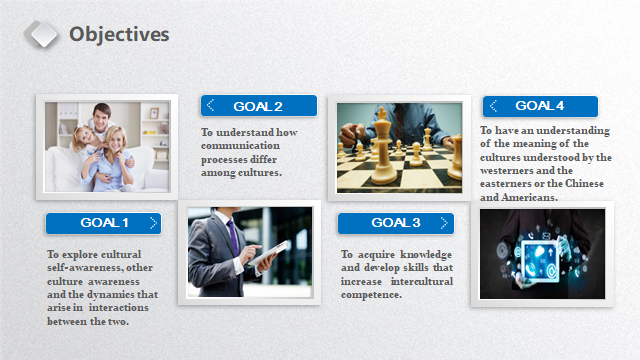
Teaching Aim

1.The general purpose of thiscourse is to understand the ways in which culture interrelates with and effectscommunication processes. 

2.Intercultural learninginvolves affective and  behavioralprocesses, as well as cognitive ones. 

3.Throughout thiscourse, you will have the  opportunityto gain knowledge, skills and attitudes that will increase your interculturalcommunication competence.


Why should welearn ICC?

1.Development of Science &Technology 

2. Globalization of Economy

3.  WidespreadImmigration

4.  Developmentof Multiculturalism

5.  InternationalCommunication

6.  InterracialCommunication

7. Interethnic Communicationor  minority communication

参考书目:

跨文化交际视听说  高等教育出版社   普通高等教育十一五国家级规划教材

跨文化交际教程,主编余卫华   谵莉   浙江大学出版社

InterculturalCommunication A Practical Course book跨文化交际实用教程