目录

  • 1 Culture
    • 1.1 Course introduction
    • 1.2 Case Study
    • 1.3 Culture
      • 1.3.1 Cultural Confidence
    • 1.4 Differences between Chinese culture and western culture
  • 2 Communication
    • 2.1 Comunication
      • 2.1.1 10 Barriers to Effective Communication
    • 2.2 Case study1
    • 2.3 Intercultural Communication
    • 2.4 Case study2
  • 3 Hofstede’s Culture
    • 3.1 Individualism and Collectivism
    • 3.2 Power distance
    • 3.3 Uncertainty Avoidance
    • 3.4 Anna and King
    • 3.5 Let's deal with China - Intercultural communication
    • 3.6 masculinity ve femininity
  • 4 Kluckhohn and Strodtbeck’s Model
    • 4.1 Case study
    • 4.2 Man and Nature
    • 4.3 Religions
  • 5 Cultural Connotation in Language
    • 5.1 Case study
    • 5.2 Language and Culture
  • 6 Norms of social Interaction
    • 6.1 Verbal communication
    • 6.2 Addressing
    • 6.3 Gratitude
    • 6.4 Taboos
    • 6.5 Case study
  • 7 Non-verbal Communication
    • 7.1 Case Study
    • 7.2 Nonverbal language
    • 7.3 How to Read Body Language
  • 8 Ethnocentrism and Stereotypes
    • 8.1 Case study
    • 8.2 Ethnocentrism
    • 8.3 Race discrimination
    • 8.4 Stereotypes
  • 9 Acculturation and Identity
    • 9.1 Acculturation
    • 9.2 Identity
    • 9.3 Case study
  • 10 Culture Shock
    • 10.1 Case study
    • 10.2 Culture shock
    • 10.3 Ethnocentrism
    • 10.4 Reverse Culture Shock
  • 11 Education
    • 11.1 Chinese education
    • 11.2 Western education
    • 11.3 Case Study
  • 12 Hall’s Culture Context Model
    • 12.1 Case study
    • 12.2 Compliment
    • 12.3 low context and High context
    • 12.4 Face-Negotiation Theory
  • 13 Family and Gender
    • 13.1 Case study
    • 13.2 Gender
    • 13.3 Wedding and Funeral customs
  • 14 Customs and Festivals
    • 14.1 Chinese festivals
    • 14.2 Western festivals
    • 14.3 Chinese cuisine
    • 14.4 Western cuisine
  • 15 Intercultural business
    • 15.1 Case study
    • 15.2 Business Negotiation
  • 16 Globalization
    • 16.1 Economic Globalization
    • 16.2 Political Globalization
    • 16.3 Cultural Globalization
Comunication


Lead-in

Can you give some examples toexplain the word communication?

Definition of Communication

Generallyspeaking, communication can be defined as a dynamic, symbolic, transactionaland contextual process(事务性和上下文的过程 )inwhich people create shared meanings or messages.

nAs social animals, humans employcommunication in every aspect of daily life. It serves to facilitate humansocialization, maintain social relationships, and develop personality. nAlthough experts have not agreed upon preciselyone definition, communicationgenerally refers to the process in which participants create and shareinformation with on another as they move toward reaching mutual understanding.
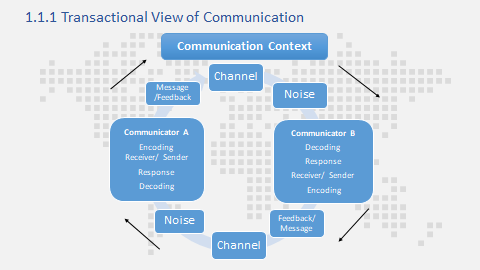


Elements


Explanations of elements


Illustration in this conversation


Context


A  setting or situation in which communication occurs


An elevator on the way to the office


Sender  


The  individual who originates a message


The man


Encoding


The process by which an idea is converted into a  message


Converting the idea of greeting into a  verbal message


Message


The information being sent


A verbal greeting (How’ve you been?)


Channel


The means by which a message is  transmitted from its origin to  its destination


Face-to  face


Receiver


The intended destination of a message


The woman


Decoding


The process by which the message is converted into an  idea


Converting the verbal message into the  idea of greeting: he’s greeting me.


Response


The reaction of the receiver to the decoded messge


Positive response to the greeting


Feedback


A message about the effects of a previous message that is sent  back to the source


A verbal message sent back: “Not bad.  ’N you?”


Noise  


Anything  that interferes with the transmission of a message


None


Classification of communication

Verbal& nonverbal

One-way&interactive

Direct& indirect

Interpersonal,interorganizational and mass media-based.

Intracultual &intercultural 

Intrapersonal& interpersonal

Intentional&unintentional

Successful& unsuccessful

Effective& ineffective

Appropriate  & inappropriate


Watchthe video clip. Try to discuss with your partner how the difference between menand women influence their ways of expression.