
平面体表面取点 getting points on the surface of planar solids
平面体表面取点,就是在该平面体某表面上取点。平面体表面取点应首先根据已知条件,分析点所在平面的空间位置,然后利用积聚性或作辅助线求出点的其余投影。
In order to make points on the surface planar solid, accumulation and auxiliary line methods are introduced in the section. Firstly, one should make sure which plane the point lies on. Secondly, he should determine what kind of the plane is,if special plane or general plane. Finally , apply to proper method to work out the projections of point.
一、积聚性法 accumulation method
当物体表面相对投影面处于特殊位置时,投影具有积聚性,即该表面上所有点的投影都在面的积聚投影上。求平行和垂直面上点的投影,可利用积聚性直接求得,这种方法称为积聚性法。
When a plane is a special plane relative to projection planes, the projection of plane has accumulation characteristics. In other word, the projections of all the points of the plane must be in the collecting projection. If the plane is a perpendicular or a parallel plane, accumulation method is a good choice.
【例 4-3】如图 4-4(a)所示,已知四棱台侧面上 K 点的正面投影 k′,求 K 点的水平投影和侧面投影。
【Eg.4-3】Accumulation method: take a frustum of rectangular pyramid as an example to illustrate the application of accumulation method. Please work out the H-projection and W-projection of point K as shown in fig 4-4.
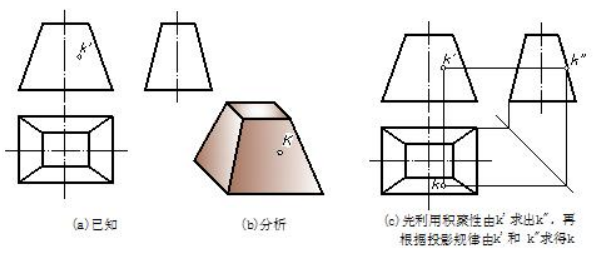
图4-4 四棱台表面取点 get point on frustum of a rectangular pyramid
分析 analysis
由于 k′可见,可知 K 点位于四棱台的前侧面上,如图 4-21(b)所示。四棱台前侧面为侧垂面,侧面投影积聚为一斜线,K 点的侧面投影 k″必定在该斜线上。
One knows the point K on the frontal side because of visibility of V – projection and as shown in fig 4-21. The frontal surface is a perpendicular plane and the W – projection is a collecting oblique line. The W – projection of point K ,that is k″must be in the oblique line.
作图 construction
① 先求画点在面积聚投影上的投影。由 k′利用积聚性和“高平齐”求出侧面投影 k″。
② 再求画点的第三投影。根据“长对正、宽相等”,由 k′和 k″求出水平投影 k。
③ 判定可见性。所求水平投影 k 可见;侧面投影 k″不可见,但在面的积聚投影上时,一般省略括号。
如图 4-4(c)所示。
Step1. Work out the projection of point in the perpendicular plane. Work out k″based on k′using accumulation and height alignment.
Step2. Complete the third projections of the point and follow projection rule, length alignment and width equality. Make k based on k′and k″.
Step3. Judge whether the projections are visible or not. It is obvious that k is visible and k″is invisible but it lies in the collecting projection , the bracket is ignored. The steps are as follows in fig 4-4.
判定可见性的原则是:点所在面的投影可见,点的该投影可见;点所在面的投影不可见,点的该投影也不可见。不可见点的投影标记应加括号,但面的积聚投影上不可见的点,可省略括号。
Tips: the visibility is essential for one to judge while getting points on the surface of solids. In fact, it is easy to do it. If the plane is visible, the lines in the plane are visible. If the line is visible, the points on the line are visible.
If a point is on the side edge, one can figure out directly based on the principle of subordination of point. However, if points are in the collecting projection, one can ignore the brackets.In the same way, learners can do some exercise to learn how to get points on a hexagonal prism.
【例 4-4】如图 4-5(a)所示,已知六棱柱表面上点 M 和 N 的正面投影 m′和(n′),求它们的水平投影和侧面投影。
【Eg.4-4】Please complete the projections of point given V-projections of point M and point N and as shown in fig 4-5.
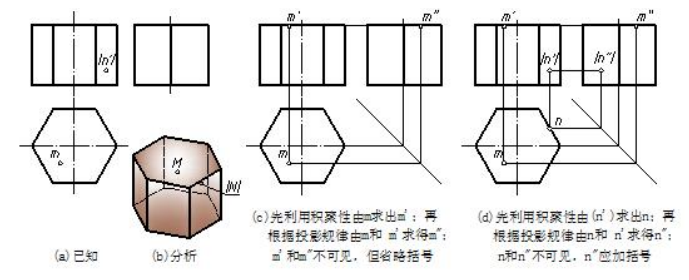
图4-5 六棱柱表面取点 get points on a hexagonal prism
分析 analysis
由于点 M 的水平投影 m 可见,可知点 M 在六棱柱的上底面上;点 N 的正面投影(n′)为不可见,又位于右侧,可知点 N 在六棱柱的右后侧面上,如图 4-22(b)所示。M、N 点所在的平面为特殊位置平面具有积聚性,故 M 点的正面投影和 N 点的水平投影可利用积聚性直接求出。作图步骤如图 4-5(c)、(d)所示。积聚投影上的点 m′、m″、n 不可见,一般省略括号。
One can determine that point M on the top face and point N on the right rear side face of solid based on the given conditions as shown in fig 4-22(b). The top face is a horizontal parallel plane, so the two projections are collecting line segments. The right and rear side plane is a h-perpendicular plane, its h-projection is collecting an oblique line. The two planes are both special plane, so accumulation method is applied to work out the projections of points.
二、辅助直线法 Auxiliary line method
当物体表面为一般位置面时,它的三面投影都没有积聚性,在这些面上取点应用辅助直线法。
When a point is on the surface of a plane which is oblique to three projection planes, auxiliary line method is always used.
【例 4-5】如图 4-6(a)所示,已知三棱锥表面上 K 点的正面投影 k′,求 K 点的水平投影和侧面投影。
【Eg.4-5】Please complete the horizontal and side vertical projections of point K based on its vertical projection of a triangular pyramid.
分析 analysis
由于 k′可见,可判定 K 点在 SAB 侧面上,如图 4-6(b)所示。SAB 侧面的三投影都是线框无积聚性,为一般位置平面,该面上的点要用辅助直线法求画。
It is easy to tell the point K on the side plane of SAB because of its visibility. The three projections of side plane of SAB are all triangles, so it is a general plane relative to projection planes. Now one can choose to draw auxiliary lines to work out the rest projections of point K.
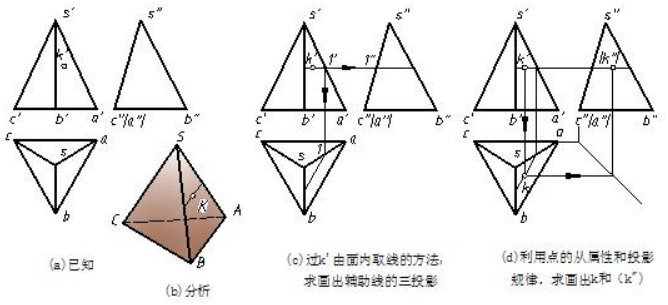
图4-6 三棱锥表面取点 get point on the surface of triangular pyramid
作图 construction
① 先求画辅助线的三投影。过已知投影 k′作辅助线平行于 a′b′并与 s′a′交于1′,依据点在平面内的几何条件求画出辅助线的水平投影和侧面投影,如图 4-6(c)所示。
② 求画 K 点的另外两面投影。利用点的从属性和“长对正”由 k′求出水平投影 k,再根据“高平齐、宽相等”由 k 和 k′求出 k″,如图 4-6(d)所示。
③ 判定可见性。SAB 侧面位于三棱锥的右侧,侧面投影不可见,该面上 K 点的侧面投影 k″也不可见,应标记为(k″);SAB 侧面的水平投影可见,该面上 K 点的水平投影 k 也可见。
Step1. Draw auxiliary line and finish three projections of line. Make aided line through k′and keep the line parallel a′b′and intersects 1′with s′a′. Try to figure out the other two projections of line and follow the graphic conditions of keeping the points in a plane.
Step2. Work out the other two projections of point K. make good use of subordination of point and projection rules to give the projections of k′and k″.
Step3. Distinguish whether the point is visible or not. The side vertical projection is invisible because of it’s on the right of solid and horizontal projection is visible.
归纳:体表面取点时,首先要判定点所在面的位置,看投影是否有积聚性,若有积聚性,可用积聚性法直接求得;若没有积聚性,就要采用辅助线法求得。
Conclusion: make sure about the plane of point lying; determine the plane as a general or special plane; points on special plane can work out directly based on accumulation feature; points on a general plane can made by drawing auxiliary line.
应指出的是:平面体各棱线上的点,均可根据投影规律直接求得。
If a point is on the side edge, one can figure out directly based on the principle of subordination of point.
【例 4-6】如图 4-7(a)所示,已知圆锥面上 A 点的正面投影 a′,求 A 点的水平投影和侧面投影。
【Eg.4-6】as shown in fig4-7(a). Please complete the projections of point A based on its vertical projection.
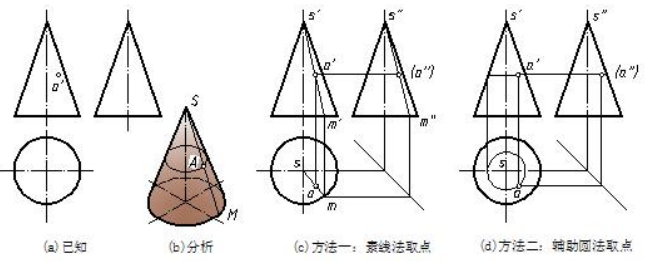
图4-7 圆锥体表面取点 get point on the surface of a cone
分析 analysis
如图 4-7(b)所示,A 点在圆锥面上,圆锥面无积聚性,应用辅助线法求。圆锥面是直线面,可利用素线作辅助线,称素线法。圆锥面又是轴线为铅垂线的回转面,该面上可作出一系列水平圆,所以又可利用水平圆作辅助线,称辅助圆法。
As we know, the point is on the conical surface and the surface is a general plane , so auxiliary method is the good choice. The conical face is made up of a line and makes generating line to be regarded as auxiliary line. At the same time, the axis of the cone is perpendicular to horizontal projection plane; one makes a series of horizontal parallel concentric circles instead of auxiliary line.
作图 construction
方法一:用素线法求 a 及 a″。如图 4-25(c)所示,连接 s′a′并延长交圆周于 m′,s′m′即为过点 A 的素线。M 点在底面上,根据投影规律由 m′可直接求出 m 和 m″,再连接 sm 和 s″m″,即得辅助线的水平投影和侧面投影。根据直线上点的从属性和点的投影规律可求画出 a 及 a″,a″不可见。
Method one: using generating line to work out horizontal and side vertical projections. As shown in fig 4-25(c). Connect s′ and a′. The extension line of s′a′ intersects m′ with the circle .the line of s′m′ is the generating line through point A. Point M is on the bottom surface and work out m and m″following projection rules. And then , join sm and s″m″in every case, obtain the horizontal and side vertical projections of the generating line. According to the subordination and projection rules of point, it is very convenient to figure out the desired projections of point A. the side vertical projection is invisible because it is located on the right and half conical surface.
方法二:用辅助圆法求 a 及 a″。如图 4-25(d)所示,过 A 点在圆锥面上作一辅助圆,辅助圆的水平投影是与底面同心的圆,正面投影和侧面投影均为水平直线。过 a′作一水平线交两侧轮廓素线,长度即为辅助圆的直径,以水平投影中心 S 为圆心,上述长度之半为半径画圆得辅助圆的水平投影,根据投影规律可求出辅助圆的侧面投影。同理,由直线上点的从属性和点的投影规律可求出 a 及 a″,a″不可见。
Method two: using auxiliary circle to obtain the horizontal and side vertical projections of point A. As shown in fig 4-25(d). Firstly, make an auxiliary circle through point A, the horizontal projection of it is a concentric circle with the bottom face. The other two projections of the auxiliary circle are both horizontal parallel lines. Secondly , draw a horizontal parallel line through a′and intersects the left and the right contour lines. The length from the two intersections is the diameter of the auxiliary circle. Thirdly, draft the auxiliary circle with the center point. Follow projection rules to figure out side vertical projection of the circle. In the same way as method one, one can give the projections of point A and determine the visibility of the projections.
如果点位于圆锥的底面或素线上,可以直接求。如果在锥曲面上,可以通过做辅助直线或辅助素线求点的投影。
If a point is the base or generators, one can work it out directly. If it is on cone surface, one must draw some auxiliary generating line or auxiliary circle to do it.
作图步骤:
判断点的位置;绘制辅助素线或辅助圆;完成辅助素线或辅助圆的投影;求点的投影;判别点投影的可见性。
Step1. Determine where the point is.
Step2. Draw auxiliary line or circle.
Step3. Finish the projections of auxiliary line or circle.
Step4. Complete the projections of points on the auxiliary line or circle.
Step4. Distinguish whether the point is visible or not.
小结 Make a conclusion
完成点的投影后,要判别其可见性;读图能力以及理解视图含义非常重要;点、线和面的投影特性;投影规律,将这些应用到解题中。
Remember to offer the visibility of point after one finishes the projections of point on the surface of solid. The ability of reading and understanding views, plays an important role in getting points on the surface of solid. One should have good understanding of projection characteristics of points, lines and planes.In other words, one should put the principle and the knowledge into practice.

