水利工程制图

武心嘉、汪艳芳

目录

  • 1 制图基本知识 Basic Knowledge of Drawing
    • 1.1 绪论 Introduction
    • 1.2 制图工具及其用法 Drawing Tools and Their Utilization
    • 1.3 国家标准有关规定 Related Provisions in National Standards
    • 1.4 几何作图geometric construction
    • 1.5 平面图形的绘制 The drawing of plane graphics
  • 2 投影的基础知识 The basics of projection
    • 2.1 投影法和投影特性 Projection method and projection properties
    • 2.2 工程中常用的四种投影图Four kinds of projection drawings commonly used in engineering
    • 2.3 物体的三面投影图 Three-sided projection of an object
  • 3 点线面的正投影 Projection of point、line and plane
    • 3.1 点的投影 Projection of Point
    • 3.2 直线的投影 Projection of Line
    • 3.3 平面的投影 Projection of Plane
    • 3.4 直线与平面、平面与平面的相对位置The position of a line relative to a plane, plane relative to a plane
  • 4 立体 Stereoscopic
    • 4.1 平面体的投影Projection ofProjection of  Planar Solids
    • 4.2 平面立体表面上的点和线 Points and lines on a planar solid surface
    • 4.3 平面立体截交线Plane stereo intersection line
    • 4.4 曲面立体的投影Stereoscopic projection of a curved surface
    • 4.5 曲面立体表面上的点和线Points and lines on the surface of a curved surface
    • 4.6 曲面立体的截交线Curved solid intersection
  • 5 立体表面相交Intersections of solids
    • 5.1 概述Overview
    • 5.2 两平面立体相交Two plane solids intersect
    • 5.3 平面体与曲面体相贯Intersections Between Planar and Curved Solids
    • 5.4 两曲面体的相贯线 The intersecting line of two curved bodies
    • 5.5 常见两曲面立体相贯线的讨论Discussion on the intersecting line of two surfaces
  • 6 组合体 composite solid
    • 6.1 组合体构成分析 Composition analysis
    • 6.2 组合体视图的画法 Composition View
    • 6.3 组合体的尺寸标注 The dimension of the assembly
    • 6.4 组合体视图的阅读 Reading the composite view
  • 7 轴测图的画法  construction of axonometric drawing
    • 7.1 轴测图的基本知识 Basic Knowledge
    • 7.2 平面体的正等测 Isometric Drawing
    • 7.3 平面体的斜二测 Cabinet Drawing
    • 7.4 曲面体的正等测 Isometric Drawing of Curved Solids
    • 7.5 曲面体的斜二测 Cabinet Drawing of Curved Solids
  • 8 工程形体的表达方法Expression methods of engineering objects
    • 8.1 视图 Views
    • 8.2 剖视图 Section View
    • 8.3 断面图 Cross Section
    • 8.4 简化画法和规定画法Simplified and prescriptive drawing
    • 8.5 视图的综合运用 Comprehensive use of views
    • 8.6 补充
  • 9 水工建筑物中常见的曲面 Curved surfaces in water conservancy project
    • 9.1 概述
    • 9.2 椭圆柱和椭圆锥
    • 9.3 双曲抛物面
    • 9.4 组合面Combination of surface
  • 10 标高投影 Projection with heights
    • 10.1 点、直线、平面 Points, lines, planes
    • 10.2 两平面的交线
    • 10.3 曲面和地形面 Curved and topographic surfaces
    • 10.4 标高投影在工程中的应用Application in engineering
  • 11 水利工程图 Hydraulic drawing
    • 11.1 水工建筑物和水工图 Hydraulic structures and drawings
    • 11.2 水利工程图表达 Expression of Hydraulic Engineering Drawing
    • 11.3 水工图的尺寸标注 Dimensioning of hydraulic drawings
    • 11.4 水工图的绘制 Drawing of hydraulic drawings
    • 11.5 水工图的阅读 Reading of hydraulic drawings
  • 12 建筑施工图Building construction drawing
    • 12.1 概述Overview
    • 12.2 建筑总平面图General plan of the building
    • 12.3 建筑平面图Construction plan
    • 12.4 建筑立面图 Elevation of Building
    • 12.5 建筑剖面图Building profile
    • 12.6 建筑详图 Architectural detailed drawing
建筑详图 Architectural detailed drawing

建筑详图 Architectural detailed drawing


       由于建筑平、立、剖面图一般采用较小的比例绘制,建筑物的某些细部及构配件的详细构造和尺寸无法表示清楚。为了满足施工的要求,必须将这些部位的形状、尺寸、材料、做法等用较大的比例详细表达出来,这种图称为建筑详图,简称详图。详图又称大样图或节点图。

       Because the plan, elevation and section drawing of the building are usually drawn in a small scale, the detailed structure and size of some details and components of the building cannot be clearly expressed. In order to meet the requirements of construction, the shape, size, material and method of these parts must be expressed in detail in a larger proportion, which is called the architectural detail map, or the detail map for short. Detail diagram is also known as large sample diagram or node diagram.

      建筑详图可分为节点构造详图和构配件详图两类。凡表达房屋某一细部的形状大小、构造做法和材料组成的详图称为节点详图,如墙身详图(包括檐口、窗台、勒脚、明沟、散水等)。凡表明构配件本身构造的详图,称为构件详图或配件详图,如门、窗详图、楼梯详图、花格详图等。

      Architectural detail drawings can be divided into two categories: joint construction detail drawings and structural parts detail drawings. The detail drawing expressing the shape, size, construction method and material composition of a certain part of the house is called node detail drawing, such as the detail drawing of the wall body (including cornice, window sill, legging foot, open ditch, water discharge, etc.). Where the details of the construction of the components themselves, known as component details or accessories details, such as door, window details, stairs, lattice details, etc.

      建筑详图的数量与房屋的复杂程度及建筑平、立、剖面图的内容及比例有关。对于引用标准图或通用详图的建筑构配件和剖面节点,只要注明所用图集的名称、页次、编号,则可不必再画详图。常用的详图主要有墙身剖面详图、楼梯详图、门窗详图、厨房、浴室、卫生间详图等。

      The number of architectural details depends on the complexity of the building and the content and proportions of the plans, elevations and sections. For the construction parts and section nodes that refer to standard drawings or general drawings, it is unnecessary to draw detailed drawings as long as the name, page number and number of the atlas used are indicated. Commonly used details of the main wall body section details, details of stairs, doors and Windows, kitchen, bathroom, toilet and so on.

举例:

图1 楼梯剖面详图
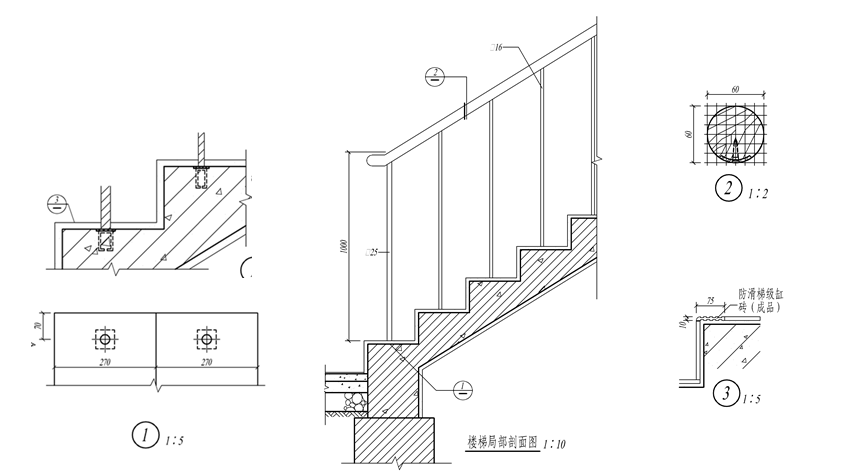
图2 楼梯节点详图

图3 门窗详图
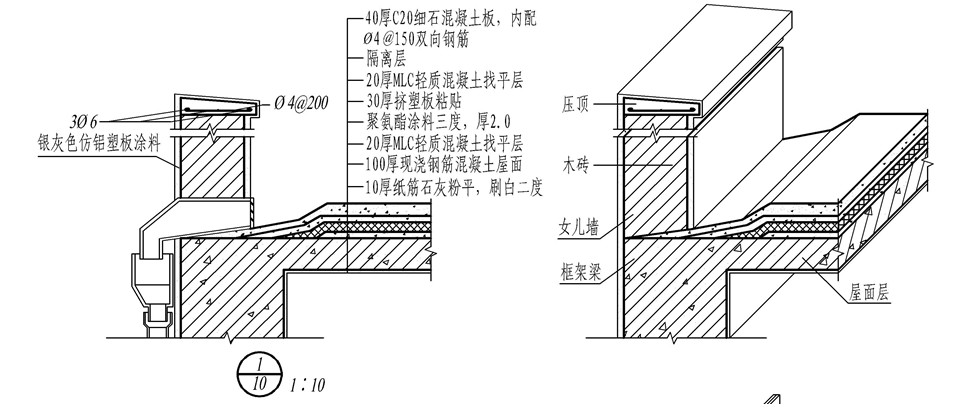
图4 外墙节点详图