
曲线面 Curve surface
在水工建筑中,为了满足结构受力、使用功能或外形美观的需要,往往较多地使用曲面体型的结构。特别是流道部分,为使水流均匀平稳,减少水头损失,并避免发生空蚀,需将结构的表面设计成符合水流流态的曲面,如尾水管、渐变段及进水喇叭口等。为此设计模板时要认真分析曲面结构,把握其特性,并尽量做成符合结构设计要求的曲面模板。
In hydraulic architecture, in order to meet the needs of structural stress, use function or beautiful appearance, curved body type is often used more frequently.Especially for the flow passage, in order to make the flow even and steady, reduce the loss of water head and avoid cavitation erosion, it is necessary to design the surface of the structure to conform to the flow pattern, such as the draft pipe, gradient section and the inlet horn.Therefore, when designing the template, we should carefully analyze the surface structure, grasp its characteristics, and try our best to make the surface template that meets the requirements of structural design.
扭曲面 twisted surface
扭曲面在水利工程中应用最广泛,通常把扭平面直接称为扭面或扭平面。
The warp surfaces are widely used in engineering. The transition section[trænˈziʃən ˈsekʃən] is from rectangular section to trapeziform section.
1.扭平面的表示方法 representation of warp surfaces
如图 8-10(a)所示,扭平面 ABCD 可以看作是一条直母线 AB,沿着两条交叉直导线 AD(侧平线)和 BC(铅垂线)运动,并始终平行于一个导平面 H(水平面)所形成的曲面;扭面 ABCD 也可以看作是一条直母线 AD,沿着两条交叉直导线 AB(水平线)和 DC(侧垂线)运动,并始终平行于一个导平面 W(侧平面)所形成的曲面。在扭面形成过程中,母线运动时每一个空间位置称为扭面的素线。同一扭面有两种方式形成,也就有两组素线。图 8-10(a)中素线Ⅰ-Ⅰ、Ⅱ-Ⅱ……都是水平线,素线Ⅰ′-Ⅰ′、Ⅱ′-Ⅱ′……都是侧平线,同一组素线之间是交叉直线关系。
Warp surface ABCD can be viewed as a straight line of AB, along two cross straight lines AD (side horizontal line) and BC (vertical) movement, and is always parallel to a guide plane (H plane) . One can get a warp surface in this way. Meanwhile one can obtain a warp surface in another way.
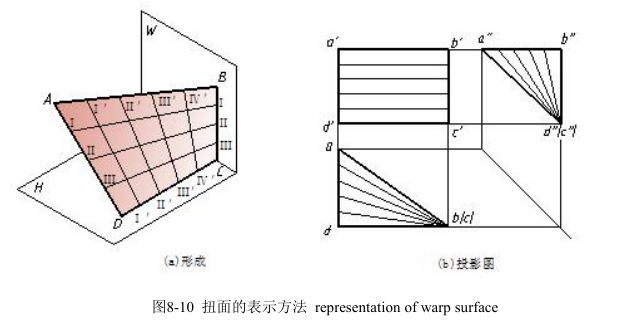
制图标准规定:扭面的主视图、俯视图上画水平素线,左视图上画侧平素线。素线的绘制方法是:等分两导线,连接对应点。
Regulations: draw horizontal generating lines in front and top views and draw profile generating lines in the left view. The way to draw generating lines is dividing two guide lines, connecting the corresponding points.
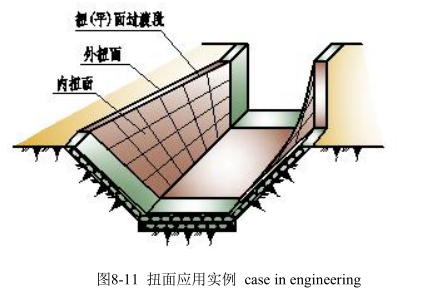
图 8-11 所示的扭面过渡段是扭平面在工程中的应用实例。在水工建筑物中,控制水流部分的断面一般为矩形,而灌溉渠道的断面一般都是梯形,为使水流平顺及减少水头损失,由矩形断面变为梯形断面之间常用一个扭面过渡段来连接,该过渡段的内外表面都是扭面,其内扭面即为图 8-10 所示的 ABCD 扭平面。
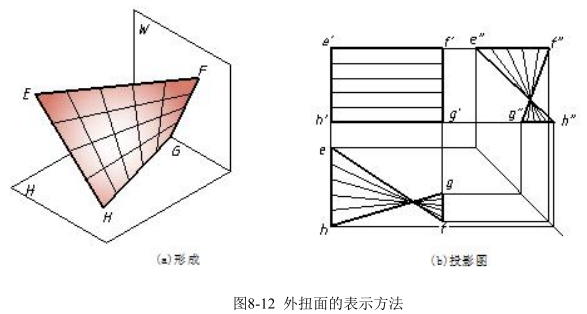
同理可分析该扭面过渡段中外扭面的形成和表示方法,如图 8-12所示。
2.扭面过渡段的画法 construction of warp surface
如图 8-13(a)所示,过渡段由扭面翼墙与底板构成。画扭面过渡段,应先按形体分析法画出底板梯形柱体,再画扭面翼墙。扭面翼墙分析:扭面翼墙由梯形端面 BCGF、平行四边形端面 ADHE、内扭面 ABCD、外扭面 EFGH、顶面 ABFE、底面 CDGH 六个面组成,起控制作用的是翼墙两个端面的形状和位置。扭面翼墙三视图的画法步骤(一般采用端面法):
(1)先画出扭面翼墙的两端面。
(2)连翼墙各侧棱。
(3)绘制内、外扭面的可见素线(注意:看不见的素线一律不画)。
1. Development of warp surface (please learn it by yourself)
2. Construction of warp surface
Detail steps are as follows. (End faces method)
Step1. Give the projection of end faces
Step2. Connect the responding points of two end faces.
Step3. Draw generating lines on the visible surfaces of internal and external wrap surfaces.
Construction steps of generating lines: divide the two guide lines into the same quantity and connect the divide points respectively with thin solid lines. Take the pictorial drawing as an example to illustrate how to draw generating lines of wrap surface. Line AB and line CD are a couple guide lines and one can divide them in the same quantity. We divide them into 10 parts as for the example, and then connect the divided points in every case with we thin lines. In the same way, one can obtain generating lines in another direction. One notes that we divide line AD and line BC into 8 parts. The quantity of divide depends on the size of shape.
扭面翼墙断面图的画法步骤:
(1)首先进行标注。确定剖切位置、投射方向,并注写字母与断面图名称。
(2)沿剖切位置线量取尺寸画底板断面。
(3)沿剖切位置线量取尺寸画翼墙断面。
(4)擦去断面中两者的分界线。
(5)画剖面材料符号。
3. Cut of wrap surface
Step1. Please label in the view (remember to label the cutting location, the direction sight, letter of sectional view and name of sectional view)
Step2. Measure the dimension of bottom plate along the cutting location.
Step3. Measure the dimension of wing wall along the cutting location.
Step4. Erase the boundary line between two kinds of materials.
Step5. Draw cross hatching.
Notice: one should keep in mind about the projection rules all the time.
Sum up: one should master how to finish three views of two special planes. One must grasp how to draw the generating lines correctly on curved surfaces.One only draws generating lines on visible surfaces and don't need to draw them on invisible surfaces.One should learn to draw generating lines in the views of oblique elliptic surfaces. One should learn to draw generating lines on the surface of wrap surfaces and gradual plane from a circle to a square.

