以下内容来自https://www.thoughtco.com/insect-larval-forms-1968484仅供同学学习使用。
Science, Tech, Math › Animals & Nature
What Are the 5 Types of Insect Larvae?
:max_bytes(150000):strip_icc():format(webp)/life-cycle-of-tawny-rajah-butterfly-538988612-5ae4e8d7a18d9e00377ccd70.jpg)
By Debbie Hadley
Updated December 12, 2019
Whether you are a dedicated insect enthusiast or a gardener trying to control a plant pest, you may need to identify immature insects from time to time.
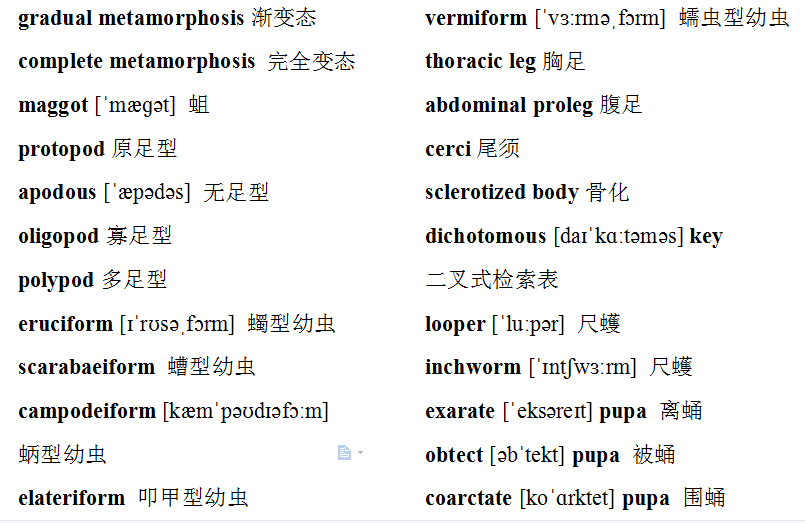
Some insects go through gradual metamorphosis in three stages from egg to nymph to adult. In their nymph stage they look essentially the same as in their adult stage except they are smaller and don't have wings.
But about 75% of insects undergo a complete metamorphosis beginning with a larval stage. In this stage, the insect feeds and grows, usually molting several times before reaching the pupal stage. The larva looks quite different from the adult it will eventually become which makes identifying insect larvae more challenging.
Your first step should be determining the larval form. You might not know the proper scientific nomenclature for a particular form of larva, but you can probably describe them in laymen's terms. Does it look like a maggot? Does it remind you of a caterpillar? Did you find some kind of grub? Does the insect seem worm-like, but have tiny legs? Entomologists describe five types of larvae, based on their body shape.
01 of 05 Eruciform
:max_bytes(150000):strip_icc():format(webp)/GettyImages-532069029-5819374a5f9b581c0bb8c4f0.jpg)
Does it look like a caterpillar?
Does it look like a caterpillar?
Eruciform larvae look like caterpillars and in most cases, are caterpillars. The body is cylindrical with a well-developed head capsule and very short antennae. Eruciform larvae have both thoracic (true) legs and abdominal prolegs.
Eruciform larvae may be found in the following insect groups:
02 of 05 Scarabaeiform
:max_bytes(150000):strip_icc():format(webp)/GettyImages-128140549-5819383e5f9b581c0bb91923.jpg)
Does it look like a grub?
Scarabaeiform larvae are commonly called grubs. These larvae will usually be curved or C-shaped, and sometimes hairy, with a well-developed head capsule. They bear thoracic legs but lack abdominal prolegs. Grubs tend to be slow or sluggish.
Scarabaeiform larvae are found in some families of Coleoptera, specifically, those classified in the superfamily Scarabaeoidea.
03 of 05 Campodeiform
:max_bytes(150000):strip_icc():format(webp)/1323013-LGPT-58193a9f3df78cc2e8333821.jpg)
Campodeiform larvae are usually predaceous and typically quite active. Their bodies are elongate but slightly flattened, with well-developed legs, antennae, and cerci. The mouthparts face forward, helpful when they are in pursuit of prey.
Campodeiform larvae may be found in the following insect groups:
04 of 05 Elateriform
:max_bytes(150000):strip_icc():format(webp)/GettyImages-123535377-58193b2a5f9b581c0bb9d223.jpg)
Does it look like a worm with legs?
Elateriform larvae are shaped like worms, but with heavily sclerotized—or hardened—bodies. They have short legs and very reduced body bristles.
Elateriform larvae are primarily found in Coleoptera, specifically the Elateridae for which the form is named.
05 of 05 Vermiform
:max_bytes(150000):strip_icc():format(webp)/GettyImages-460713669-58193b795f9b581c0bb9e945.jpg)
Does it look like a maggot?
Vermiform larvae are maggot-like, with elongate bodies but no legs. They may or may not have well-developed head capsules.
Vermiform larvae may be found in the following insect groups:
Now that you have a basic understanding of the 5 different forms of insect larvae, you can practice identifying insect larvae using a dichotomous key provided by the University of Kentucky Cooperative Extension Service.
Sources
Capinera, John L. (ed.) Encyclopedia of Entomology, 2nd edition. Springer, 2008, Heidelberg.
“Entomologists' Glossary.” Entomologists' Glossary - Amateur Entomologists' Society (AES).
“Glossary.” BugGuide.Net.
“Recognizing Insect Larval Types.” Entomology.
Triplehorn, Charles A. and Johnson, Norman F. Borror and DeLong's Introduction to the Study of Insects, 7th edition. Cengage Learning, 2004, Independence, Ky.
以下内容来自https://zhidao.baidu.com/question/502252041189894484.html仅供同学学习
蝴蝶和蛾子的幼虫:
1、 囊套型:体外有囊形套,并附有植物和其它物质碎片。
 如蓑蛾科
如蓑蛾科
2、蛞蝓型:扁平,头小,缩在前胸内。


如,刺蛾科、灰蝶科
3、尺蠖型:除臀足外,只有1对腹足,行走时一曲一伸。
 如:尺蛾科
如:尺蛾科
4、 伪尺蠖型:除臀足外,腹足2-3对,金翅夜蛾亚科。

5、举尾型notodontiform:腹足4对,臀足退化或变形上举。

如舟蛾科、钩蛾科
6、尾角型:除臀足外,腹足4对,第八腹背面有尾角,如天蛾科,蚕蛾科。

7、Y腺型:除臀足外,腹足4对,前胸背板有可翻出的Y或V型 腺体。
 如:凤蝶科
如:凤蝶科
8、刺躅型:除臀足外,腹足4对,体上有分支的刺,如蛱蝶科、天蚕蛾科。


9、毛虫型:除臀足外,腹足4对,体被或长或短的次生刚毛,或毛瘤,如斑蛾科、灯蛾科、毒蛾科、枯叶蛾科、粉蝶科。


10、真躅型eruciform:腹足4对,臀足1对,体上仅被稀少的原生刚毛,如螟蛾科,大多数鳞翅目幼虫属此型。