跨文化交际(23242英语/翻译专业)

要文静范京晶高安阳

目录

  • 1 Culture
    • 1.1 Course introduction
    • 1.2 Case Study
      • 1.2.1 Shanxi Pasta Culture
    • 1.3 Culture
      • 1.3.1 Cultural Confidence
    • 1.4 Differences between Chinese culture and western culture
  • 2 Communication
    • 2.1 Comunication
      • 2.1.1 10 Barriers to Effective Communication
    • 2.2 Case study
  • 3 Intercultural Communication
    • 3.1 Intercultural Communication
    • 3.2 Case study
  • 4 Hofstede’s Culture
    • 4.1 Individualism and Collectivism
    • 4.2 Power distance
    • 4.3 Uncertainty Avoidance
    • 4.4 Anna and King
    • 4.5 Let's deal with China - Intercultural communication
    • 4.6 masculinity ve femininity
  • 5 Kluckhohn and Strodtbeck’s Model
    • 5.1 Case study
    • 5.2 Man and Nature
  • 6 Cultural Connotation in Language
    • 6.1 作业视频分析与展播
    • 6.2 Language and Culture
    • 6.3 Case study
  • 7 Norms of social Interaction
    • 7.1 Verbal communication
    • 7.2 Addressing
    • 7.3 Gratitude
    • 7.4 Taboos
    • 7.5 Case study
  • 8 Non-verbal Communication
    • 8.1 Case Study
    • 8.2 Nonverbal language
    • 8.3 How to Read Body Language
  • 9 Ethnocentrism and Stereotypes
    • 9.1 Case study
    • 9.2 Ethnocentrism
    • 9.3 Race discrimination
    • 9.4 Stereotypes
  • 10 Acculturation and Identity
    • 10.1 Acculturation
    • 10.2 Identity
    • 10.3 Case study
  • 11 Culture Shock
    • 11.1 Case study
    • 11.2 Culture shock
    • 11.3 Ethnocentrism
    • 11.4 Reverse Culture Shock
  • 12 Education
    • 12.1 Chinese education
    • 12.2 Western education
    • 12.3 Case Study
  • 13 Hall’s Culture Context Model
    • 13.1 Case study
    • 13.2 low context and High context
    • 13.3 Compliment
    • 13.4 Face-Negotiation Theory
  • 14 Family and Gender
    • 14.1 Case study
    • 14.2 Gender
    • 14.3 Wedding and Funeral customs
  • 15 Intercultural business
    • 15.1 Case study
    • 15.2 Business Negotiation
  • 16 Globalization
    • 16.1 Economic Globalization
    • 16.2 Political Globalization
    • 16.3 Cultural Globalization
  • 17 参考章节Customs and Festivals
    • 17.1 Chinese festivals
    • 17.2 Western festivals
    • 17.3 Chinese cuisine
    • 17.4 Western cuisine
Man and Nature

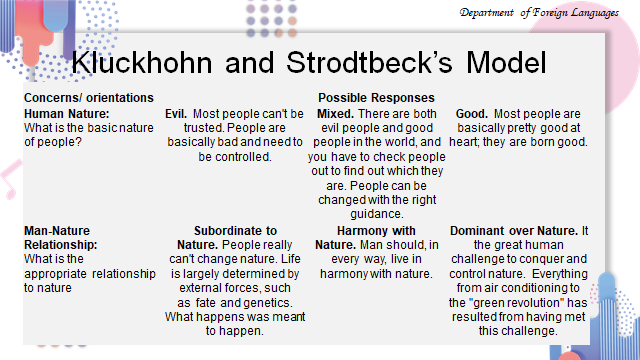
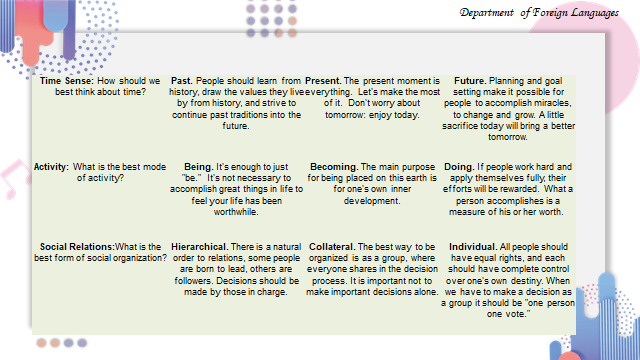
The Value Orientations MethodThefoundations for VOM were developed in the 1940s and 1950s by anthropologistswith the Harvard Values Project (Kluckhohn & Strodtbeck, 1961). The project team proposed thatit is possible to distinguish cultures based on how they each addressed fivecommon human concerns. They did not propose that these were the only fiveconcerns but that they were useful in understanding cultural differences.


Corevalues

Theyalso proposed from their study that cultures could respond to the problems inat least three ways and that all cultures would express each of the threeresponses. It was the rank order of responses that gave a culture itscharacter. They called these responses to the five concerns "valueorientations." Todaywe might call them "core values." Kohls (1981) provides a brief introduction tothe five human problems and the three possible responses .