-
1 知识内容
-
2 作业
学习目标
1. 了解维多利亚时代英国的政治、经济、文化历史背景等
2 .了解维多利亚时代英国文学特点、主要作家及代表作品
3 .了解维多利亚时代英国著名小说家 ( 狄更斯、萨克雷、哈代、勃朗特姐妹、伊丽莎白 · 盖斯凯尔 ) 及诗人(丁尼生、勃朗宁夫妇)的生平、代表作品、写作特点,并欣赏他们的代表作品。
学习指南
本课主要内容是了解英国维多利亚时代的历史背景、文学思潮特点以及该时代主要作家的生平、主要作品、写作特点,并通过作品选读加深体会,增强对作品的理解和鉴赏能力。
主要授课形式为以教师讲授为主的教学模式,即,教师课堂授课,辅以课件、视频等多媒体手段。课后配有相应习题,加深学生对英国维多利亚时期文学作品中改革对文学作品的影响,培养学生赏析该时期主要作品的能力。
知识内容
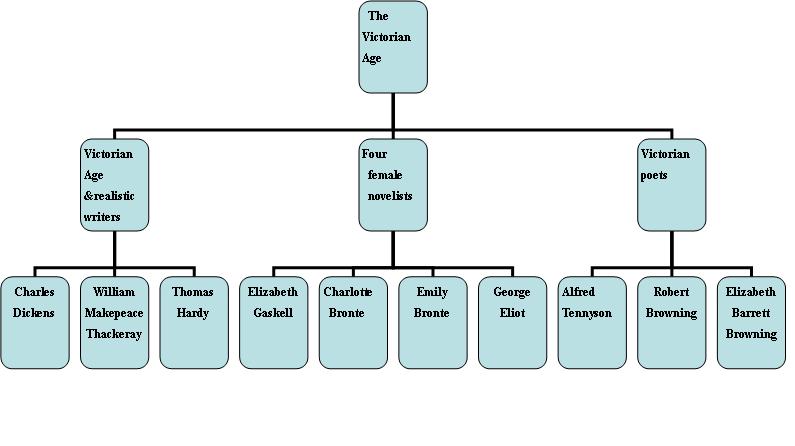
The Victorian Age
• Introduction of the Victorian Age:
the Victorian historical background, literature
Charles Dickens
William Makepeace Thackeray
Thomas Hardy
2. Four female novelists:
Elizabeth Gaskell
Charlotte Bronte
Emily Bronte
George Eliot
3. Victorian poets:
Alfred Tennyson
Robert Browning
Elizabeth Barrett BrowningThe Victorian Age
• Introduction of the Victorian Age:
the Victorian historical background, literature
Charles Dickens
William Makepeace Thackeray
Thomas Hardy
2. Four female novelists:
Elizabeth Gaskell
Charlotte Bronte
Emily Bronte
George Eliot
3. Victorian poets:
Alfred Tennyson
Robert Browning
Elizabeth Barrett Browning
实践
Appreciate the excerpt from Great Expectations .
MY FATHER'S FAMILY NAME BEING PIRRIP, and my Christian name Philip, my infant tongue could make of both names nothing longer or more explicit than Pip. So, I called myself Pip, and came to be called Pip.
I give Pirrip as my father”s family name, on the authority of his tombstone and my sister – Mrs Joe Gargery, who married the blacksmith. As I never saw my father or my mother, and never saw any likeness of either of them (for their days were long before the days of photographs).
Ours was the marsh country, down by the river, within, as the river wound, twenty miles of the sea. My first most vivid and broad impression of the identity of things, seems to me to have been gained on a memorable raw afternoon towards evening.
“Hold your noise!” cried a terrible voice, as a man started up from among the graves at the side of the church porch. “Keep still, you little devil, or I'll cut your throat!”
A fearful man, all in coarse grey, with a great iron on his leg. A man with no hat, and with broken shoes, and with an old rag tied round his head. A man who had been soaked in water, and smothered in mud, and lamed by stones, and cut by flints, and stung by nettles, and torn by briars; who limped, and shivered, and glared and growled; and whose teeth chattered in his head as he seized me by the chin.
“O! Don't cut my throat, sir,” I pleaded in terror. “Pray don't do it, sir.”
“Tell us your name!” said the man. “Quick!”
“Pip, sir.”
“Show us where you live,” said the man. “Pint out the place!”
I pointed to where our village lay, on the flat in-shore among the alder-trees and pollards, a mile or more from the church.
The man, after looking at me for a moment, turned me upside down, and emptied my pockets. There was nothing in them but a piece of bread.
“You young dog,” said the man, licking his lips, “what fat cheeks you ha' got.”
I believe they were fat, though I was at that time undersized for my years, and not strong.
“Darn Me if I couldn't eat em,” said the man, with a threatening shake of his head, “and if I han't half a mind to't!”
I earnestly expressed my hope that he wouldnt, and held tighter to the tombstone on which he had put me; partly, to keep myself upon it; partly, to keep myself from crying.
“Now lookee here!” said the man. `Where”s your mother?”
“There, sir!” said I.
He started, made a short run, and stopped and looked over his shoulder.
“There, sir!” I timidly explained. “Also Georgiana. That”s my mother.”
“Oh!” said he, coming back. “And is that your father alonger your mother?”
“Yes, sir,” said I; “him too; late of his parish.”
“Ha!” he muttered then, considering. “Who d'ye live with –supposin' you're kindly let to live, which I han't made up my mind about?”
“My sister, sir – Mrs Joe Gargery – wife of Joe Gargery, the blacksmith, sir.”
“Blacksmith, eh?” said he. And looked down at his leg.
After darkly looking at his leg and me several times, he came closer to my tombstone, took me by both arms, and tilted me back as far as he could hold me; so that his eyes looked most powerfully down into mine, and mine looked most helplessly up into his.
案例
Charles Dickens
1. The First Period of His Literary Career
This period is referred to those years from1836 to 1841. It is marked for youthful optimism. Dickens believed that all the evils of the capitalist world would be remedied if only men treated each other with kindliness, justice, and sympathetic understanding. He thought that the social problems would be solved if only every employer reformed himself according to the model set by the benevolent gentlemen in his novels and if only the rich used their power and wealth sympathetically to assist the poor to escape from poverty. This native optimism is the characteristic of the petty-bourgeois humanitarians of his time.
The main novels written in this period by Dickens are:
The Pickwick Papers
Oliver Twist
Nicholas Nickleby
The Old Curiosity Shop
2. The Second Period of his Literary Career
The second period, which began from 1842,was a period of excitement and irritation. In this period, Dickens made a trip to America . Before the visit, he thought of the United State as a world in which there were no class division and human relations were humanitarian. But what impressed him most during his visit there was the rule of the dollar and the enormously corruptive influence of wealth and power. Vulgar selfishness, which prevailed everywhere, concealed the fine qualities of the people. Dickens's naïve optimism toward the capitalist society was profoundly shaken. The main novels produced in this period are:
Martin Chuzzlewit
Dombey and Son
David Copperfield
3. The third period if his literary career:
Dickens' works in this period show intensifying pessimism. Dickens, consciously and subconsciously, shows himself more and more at odds with bourgeois society and more aware of the absence of any readily available alternative. His main novels produced in this period are:
Hard Times
Great Expectations
A Tale of Two Cities
4. Characteristics of Charles Dickens's Novels
• Dickens's novels offer a most complete and realistic picture of the English bourgeois society of his age. They reflect the realistic picture of the people against capitalist exploitation, and criticize the vices of capitalist society.
• Dickens is a petty bourgeois intellectual. He could not overstep the limits of his class. He believed in the moral self-perfection of the wicked propertied classes. He failed to see the necessity of a bitter struggle of the oppressed against their oppressors. There is a definite tendency for a reconciliation of the contradictions of society. That is why most of his novels have happy endings.
• His novels tell much of the unhappy experiences of his own childhood.
• Dickens is a great humorist and satirist. His novels are full of humor and satire.
William Makepeace Thackeray
Features of Thacheray's Novels
1) Just like Charles Dickens, Thacheray is one of the greatest critical realists of the 19 th century Europe . He paints life as he has seen it. With his precise and thorough observation, rich knowledge of social life and of the human heart, the pictures in his novels are accurate and true to life.
2) Thacheray is a satirist. His satire is caustic and his humour subtle.
3) Besides being a realist and satirist, Thacheray is a moralist. His aim is to produce a moral impression in all his novels.
Features of Eliot's Novels
1) Her novels, for the most part, describe rural life, deal with moral problems and contain psychological studied of the characters.
2) She has rich humor and keen observation, and her characters are real men and women of her times. She writes very faithfully about the rural artisans, farmers, the country clergy, and other native people, and she fully realizes that the working people like Adam Bede and Silas Marner are much better than the landed aristocracy.
3) Her novels are very philosophical. The philosophy she preached is idealistic. She believe that all contradictions of social life can be solved by converting mankind to the religion of humanity,
4) With her the transition from critical realism to naturalism began in English literature.
常见问题
1. What was the problem of women in the Victorian age?
2. Tell the characteristics of Alfred Tennyson's poetry.
3. What are the features of Robert Browning's poetry?
Keys:
1. At the time, sexual inequality in politics, economic life, degraded as second-class citizens. Many of the religious sermons as well as secular writings were eloquent in defining and reaffirming women's position and role in the society. On the other hand, the explosive growth of industry, especially the textile industry, brought hundreds of thousands of women into factory jobs. And factory work presented an increasing challenge to the conventional ideas of women and opened up new and wide spheres for them. Women now were able to walk out of the home, to share part of the responsibility of men and help support the family, and, at the same time, were entering into social services.
2. Characteristics of Alfred Tennyson's poetry can be thus summarized:
Tennyson has a total mastery of the sounds and rhythms of the English Language. Tennyson has a genius for evoking moods and states of mind in his poems. He is able to create a sense of nostalgia, a wistful longing for the past or for remote experiences. No English poet surpasses Tennyson at linking descriptions of nature or setting to state of mind. Some of his poems deal with the main political, religious and scientific issues of his day. His poems reflect his conservative ideas and idealization of the bourgeois social reality.
3. Robert Browning's great contributions to poetry are his dramatic monologues, i.e. poems in which a character or a situation is expressed by words put into the mouth of the character himself. He is realistic, much concerned with presenting facts and analyzing human psychology. He is optimistic and believes in the progress of mankind.
知识结构