-
1 知识内容
-
2 作业
学习目标
1. 了解欧洲启蒙运动对英国文学的影响。
2. 掌握 18 世纪英国文学的三个阶段的特点和代表作家及作品。
3. 了解新古典主义及代表人物蒲伯的贡献。
4. 了解笛福及其作品《鲁宾逊漂流记》。
5. 了解史威夫特及其作品《格列弗游记》。
6. 了解彭斯生平、文学成就。
7. 赏析彭斯代表作品。
8. 了解布莱克生平、文学成就。
9. 赏析彭斯代表作品。
学习指南
本课知识点 1 中内容包括欧洲启蒙运动的历史背景及其对英国文学的影响、这一时期英国文学三个阶段的特征、主要作家及代表作品,新古典主义及代表人物蒲伯 ; 赏析笛福作品《鲁宾逊漂流记》及史威夫特及其作品《格列弗游记》。
在知识点 2 中介绍彭斯、布莱克的生平及文学成就,并分别欣赏他们的主要诗歌作品。
授课形式以教师讲授为主、学生报告及课堂讨论相结合,帮助学生更好地了解这一时期的特点。通过使用多媒体手段与学生共同赏析彭斯、布莱克的代表诗歌,了解其写作特点、诗歌主题及其寓意。在感受英国诗歌魅力的同时提高鉴赏文学作品的水平、培养独立分析理解文学作品的能力。
知识内容
知识点 1
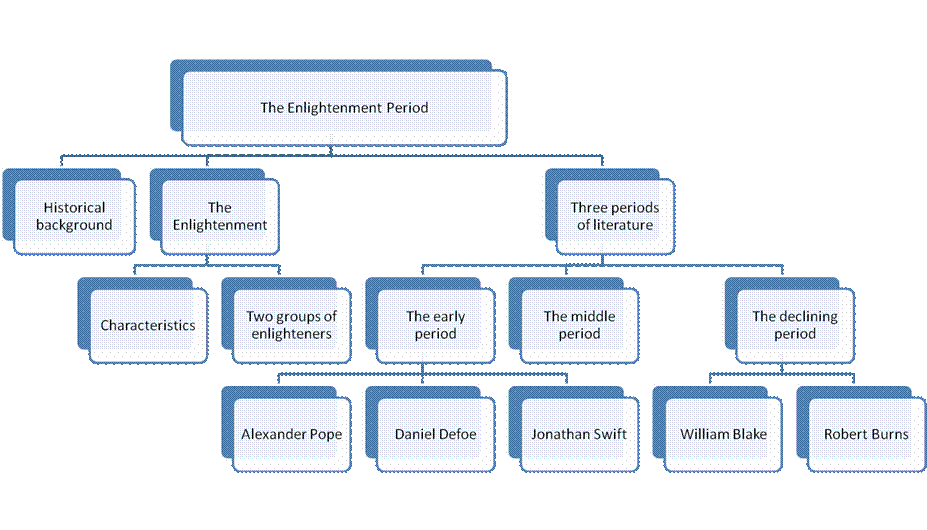
The Enlightenment Period
I. Historical and social background
II. The Enlightenment
A. Characteristics of the Enlighteners
B. Two groups of English Enlighteners
III. English literature in the 18th century
A. Features
B. Three periods of the 18 th century
1. The early period
a. Neoclassicism
b. Alexander Pope
2. The middle period
3. The declining period
a. Sentimentalism
b. Pre-romanticism
IV. Daniel Defoe
A. Literary contributions
B. Defoe's writing style
C. Robinson Crusoe
V. Jonathan Swift
A. Literary contribution
B. Major works
C. Gulliver's Travels
知识点 2
William Blake & Robert Burns
I. William Blake
A. Life
B. Literary contributions and features
C. Major works
D. Appreciation of London
II. Robert Burns
A. Life
B. Literary contributions
C. Major works
D. Features of his works
E. Appreciation of A Red, Red Rose and Auld Lang Syne
实践
1. Study the characteristics of the “Gothic novels”.
2. Appreciate Robinson Crusoe and write a report on the theme and characterization.
3. Appreciate Burn's poem A Red, Red Rose and try to write a poem in the same rhyme scheme.
案例
Enlightenment ( 启蒙运动 ): (also called the neoclassic movement): the philosophical and artistic movement growing out of the Renaissance and continuing until the nineteenth century. The Enlightenment was an optimistic belief that humanity could improve itself by applying logic and reason to all things. It rejected untested beliefs, superstition, and the “barbarism” of the earlier medieval period, and embraced the literary, architectural, and artistic forms of the Greco-Roman world. Enlightenment thinkers were enchanted by the perfection of geometry and mathematics, and by all things harmonious and balanced. The period's poetry, as typified by Alexander Pope, John Dryden, and others, attempted to create perfect, clockwork regularity in meter. Typically, these Enlightenment writers would use satire to ridicule what they felt were illogical errors in government, social custom, and religious belief.
也称新古典主义运动 , 是一场发轫于文艺复兴时期 , 一直持续到 19 世纪的哲学及艺术运动。这一运动对人类将理性及逻辑应用到万物从而提升自我的信念持乐观态度。在运动中所有未经验证的思想、迷信以及中世纪早期的 “ 蒙昧野蛮 ” 都被抵制,而古希腊,古罗马时期的文学、建筑以及艺术形式得到了顶礼膜拜。启蒙主义思想家对几何数学以及所有平衡和谐事物的完美深深着迷。这一阶段的诗歌,以亚历山大.蒲泊、约翰.德来顿及其他诗人为代表,力图创作在音节韵律上像时钟一样具有规律性的完美文学作品。这些启蒙主义思想家尤其善于应用讽刺来嘲讽政府、社会风俗以及宗教信仰中所具有的不合逻辑的错误。
Literary features of the Enlightenment period:
The main literary stream of the 18 th century was realism. What the writers described in their works were social realities. The man characters were usually common men. Most of the writers concentrated their attention on daily life. In this century the newspaper and the magazine, became the chief instrument of the nation's progress. The new social and political conditions demanded expressions not simply in books but more especially in pamphlets, magazines and newspapers. Poetry, which had been the glory of English literature in the preceding ages, was inadequate for such a task. So prose had a rapid development in this age. The 18 th century was an age of prose. A group of excellent prose writers, such as Addison, Steele, Swift, Fielding, were produced.
Novel writing made a big advance in this century. The main characters in the novels were no longer kings and nobles but the common people.
In this age satire was much used in writing. Since there was fierce strife of the two political parties in society, nearly every writer of this century was employed and rewarded by Whigs or Tories for satirizing their enemies. English literature of this age produced some excellent satirists, such as Pope, Swift and Fielding.
常见问题
1. What is the Enlightenment?
The Enlightenment was a progressive intellectual movement throughout Western Europe in the 18th century and in Russia in the 19th century.
England developed its own Enlightenment in the 18th century, which was known as the Age of Enlightenment (1680s-1789) or the Age of Reason.
It is so called because the enlighteners considered that the chief means for the betterment of society was “enlightenment” or education for the people.
The enlighteners also believed in the power of reason, regarding it as the yardstick for the measure of all human activities and social relations.
They celebrated reason, equality, science and people's ability to perfect themselves and the society.
2. What is neoclassicism?
Neo-classicism was a revival of classicism in literature in the late 17th and 18th centuries.
The neoclassicists admired the Greek and Roman literature and imitated the fixed laws and rules.
Neoclassicists put stress on the classical ideals of order, logic, restrained emotion and accuracy.
And Neoclassic poetry,mainly adopting the form of heroic couplet, was elegant in structure, serious in tone but deficient in imagination.
The representative writers were Alexander Pope, Joseph Addison, Richard Steel, Daniel Defoe and Jonathan Swift.
3. The characteristics of Burns's poetry
Burns' peasant origin and close contact with common people made him a people's poet. He wrote about common people and Scottish life, especially the rural life of peasants.
His poems were characterized by beautiful lyricism with clear hatred and affection. And his poems were attractive with pleasant humor and sometimes acid satire.
Most of his poems and songs were written in Scotch dialect. His works followed the old Scotch song tradition in terms of simplicity, humor, directness and optimism.
His poems were excellent in using diverse stanza forms and styles.
知识结构