目录

  • 1 Week 1: Course overview [F2F] (第1周:课程概览 [课堂] )
    • 1.1 Instruction (导语)
    • 1.2 Syllabus & Rubrics(教学大纲与评分规则)
    • 1.3 Health policy evaluation and econometrics? (卫生政策评估与计量经济学)
    • 1.4 Peer collaboration: Knowledge points mind map(同伴协作:知识点思维导图)
  • 2 Week 2:Estimator properties [F2F] (第二周:估计量性质 [课堂])
    • 2.1 Instruction (导语)
    • 2.2 Understand the estimation process (理解估计过程)
    • 2.3 Peer collaboration: Knowledge points mind map(同伴协作:知识点思维导图)
  • 3 Week 3: Hypothesis testing [Online] (假设检验 [线上])
    • 3.1 Instruction (导语)
    • 3.2 Hypothesis testing (假设检验)
    • 3.3 Education gradient of health behaviors (健康行为的教育梯度)
    • 3.4 Peer collaboration and Q&A (同伴协作与答疑讨论)
  • 4 Week 4: Selection of control variables [Online] (第3周:控制变量选择 [线上])
    • 4.1 Instruction (导语)
    • 4.2 Model specification (模型设定)
    • 4.3 Confirmatory bias and health decisions (认知偏差与健康决策)
    • 4.4 Peer collaboration and Q&A  (同伴协作与答疑讨论)
  • 5 Week 5: Omitted variable bias and instrumental variable technique [Online] (遗漏变量偏差与工具变量 [线上])
    • 5.1 Instruction (导语)
    • 5.2 Omitted variable bias (遗漏变量偏差)
    • 5.3 IV method (工具变量法)
    • 5.4 Peer collaboration and Q&A  (同伴协作与答疑讨论)
  • 6 Week 6: Vertical case discussions and critiques of instrumental variable technique applications [F2F] (工具变量法应用的纵向案例讨论与品鉴 [课堂])
    • 6.1 Instruction (导语)
    • 6.2 Vertical case discussion (案例纵向讨论)
    • 6.3 News article sharing (学生新闻分享)
  • 7 Week 7: Principles of panel data approaches [online] (面板数据处理方法 [线上])
    • 7.1 Instruction (导语)
    • 7.2 Waiting time and hospital costs (等待时间与医院成本)
    • 7.3 Panel data model: method (面板数据处理方法)
    • 7.4 Peer collaboration and Q&A  (同伴协作与答疑讨论)
  • 8 Week 8: Vertical case discussions and critiques of panel data approaches applications [face-to-face] (面板数据处理方法的纵向案例讨论与品鉴 [课堂])
    • 8.1 Introduction (导语)
    • 8.2 Vertical case discussion (案例纵向讨论)
    • 8.3 News article sharing (学生新闻分享)
  • 9 Week 9: Principles of difference-in-differences model [online] (双重差分模型 [线上])
    • 9.1 Instruction (导语)
    • 9.2 Classical DID model (经典双重差分)
      • 9.2.1 A simple example(一个经典例子)
    • 9.3 Peer collaboration and Q&A  (同伴协作与答疑讨论)
  • 10 Week 10: Vertical case discussions and critiques of DID model applications [face-to-face] (双重差分方法的纵向案例讨论与品鉴 [课堂])
    • 10.1 Introduction (导语)
    • 10.2 Vertical case discussion (案例纵向讨论)
  • 11 Week 11: Principles of regression discontinuity design [online] (断点回归设计 [线上])
    • 11.1 Instruction (导语)
    • 11.2 Technical notes of RDD (断点回归的技术要点)
    • 11.3 Retirement and healthcare utilization (退休与卫生服务利用)
    • 11.4 Peer collaboration and Q&A  (同伴协作与答疑讨论)
  • 12 Week 12: Vertical case discussions and critiques of regression discontinuity design applications [face-to-face] (断点回归设计的纵向案例讨论与品鉴 [课堂])
    • 12.1 Introduction (导语)
    • 12.2 Vertical case discussion (案例纵向讨论)
    • 12.3 News article sharing (学生新闻分享)
  • 13 Week 13: Health policy evaluation and the comprehensive application of econometric models [online] (卫生政策评估与计量模型综合应用 [线上])
    • 13.1 Introduction (导语)
    • 13.2 A comprehensive application (一个综合应用)
    • 13.3 Physician labor market: economic theories(卫生人力市场理论)
    • 13.4 Health insurance policy and physician behaviors (医疗保险政策与医生行为)
    • 13.5 Immunization economics (疫苗经济学)
  • 14 Week 14: Horizontal case discussions and critiques in the application of health policy evaluation [face-to-face] (卫生政策评估应用的横向讨论与品鉴 [课堂])
    • 14.1 Introduction (导语)
    • 14.2 Xintong's talk: prosocial motivation among blood donors (学生讲座:献血者的亲社会动机)
      • 14.2.1 Kristian's Talk: Occupaiton and Health (学生讲座:职业选择与健康)
      • 14.2.2 News article sharing (学生新闻分享)
  • 15 Week 15-1: student practical applications and presentations [online] (学生汇报 [线上])
    • 15.1 Introduction (导语)
    • 15.2 Ye Ma
    • 15.3 Yining Wang
    • 15.4 Tao Yu
    • 15.5 Hongjie Chu
  • 16 Week 15-2: student practical applications and presentations [online] (学生汇报 [线上])
    • 16.1 Introduction (导语)
    • 16.2 Yuting Sun
    • 16.3 Ziyi Chen
    • 16.4 Shuang Zeng
    • 16.5 Jingrao Li
  • 17 Week 16: student practice peer evaluations and discussions [face-to-face] (同伴评价与讨论)
    • 17.1 Introduction (导语)
    • 17.2 Peer collaboration and Q&A  (同伴协作与答疑讨论)
Instruction (导语)

Instruction (导语)

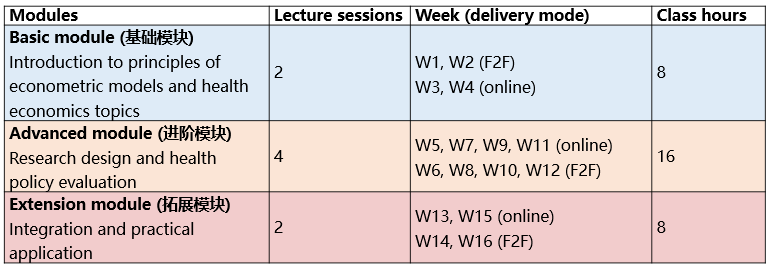
Hello, PHPM110062 fans! Welcome to the course! We will soon embark on a journey to explore how econometric methods can be used to evaluate health policies and healthcare reforms. The course consists of three modules as listed below. The delivery will be hybrid  with about half online lecture and half classroom discussions. You may find learning objectives, activities, assignments, slides and case materials on the "instruction page" for each week. Have fun and see you soon in class!  (PHPM110062课程的选修学生们,大家好!欢迎来到本课程!我们即将开始一场探索计量经济学方法如何用于评估卫生政策和改革的旅程。课程由下方列出的三个模块组成。教学方式为混合式,一半线上授课一半课堂讨论。在每周的“导语”页面,可以找到当周的学习目标、学习活动以及作业、幻灯片和案例素材等资料。期待在课堂中见到你!)


Learning goals for the basic module (基础模块的教学目标) 

The learning goals for the basic module "Introduction to principles of econometric models and health economics topics " include:

1. acquire a firm understanding in the estimation process and related concepts

2. gain the knowledge of interpreting results from classical econometric models

3. obtain a preliminary understanding of the importance of econometric models in health policy evaluation

Instruction for Week 1 (第一周学习导语) 

We will meet in class this week. Let's first go through the syllabus together and then have an overview of the course. 

    1. Learning objectives (学习目标) 

      - get familiar with the syllabus and course structure

      - understand the importance of exploring causality for health policy 

    2. Key knowledge points (核心知识) 

      - key features of the healthcare market

      - differences between causation and correlation 

      - causation and policy implication   

    3. Learning activities (学习活动) 

      - F2F lecture

      - classical case example: Chocolate consumption and innovation [Messerli (NEJM,2012)]

    4. Learning assessment (测评反馈) 

      - peer collaboration: knowledge points mind map