目录

  • 1 Chapter 1 Course Introduction
    • 1.1 Learner's Guide
    • 1.2 Preview and pretest
      • 1.2.1 Preview and pretest
      • 1.2.2 Preview video 2
    • 1.3 Sizheng (思政) elements
    • 1.4 In-class learning
      • 1.4.1 Powerpoint
      • 1.4.2 Other teaching material
    • 1.5 Close to interpreters
    • 1.6 Self-assessment
      • 1.6.1 Post test on general knowledge
    • 1.7 Extended reading--academic frontier
  • 2 Chapter 2 Effective Listening
    • 2.1 Learner's guide
    • 2.2 Preview and pretest
      • 2.2.1 Priority in listening: getting speaker's intention
      • 2.2.2 Information structuring
      • 2.2.3 Information structuring for “cloudy” speeches
    • 2.3 Sizheng (思政) elements
    • 2.4 In-class learning
      • 2.4.1 Powerpoint
      • 2.4.2 Video
    • 2.5 Close to interpreters
    • 2.6 Self-assessment
    • 2.7 Extended reading--academic frontier
    • 2.8 Feedback
  • 3 Chapter 3 Memorization
    • 3.1 Learner's guide
    • 3.2 Preview and pretest
      • 3.2.1 Interpreting and memory
      • 3.2.2 Memory expansion
      • 3.2.3 Visualization:method and demo
      • 3.2.4 Working memory mechanism
      • 3.2.5 More related micro lectures
    • 3.3 Sizheng (思政) elements
    • 3.4 In-class learning
      • 3.4.1 Powerpoint
      • 3.4.2 Exercise I
      • 3.4.3 Exercise II
    • 3.5 Close to interpreters
    • 3.6 Self-assessment
      • 3.6.1 Self-assessment
    • 3.7 Extended reading--academic frontier
    • 3.8 Feedback
  • 4 Chapter 4 Note taking
    • 4.1 Learner's guide
    • 4.2 Preview and pretest
      • 4.2.1 Content of notes
      • 4.2.2 Layout of notes
      • 4.2.3 Abbreviations & symbols
    • 4.3 Sizheng (思政) elements
    • 4.4 In-class learning
      • 4.4.1 Powerpoint
      • 4.4.2 Class recording 1
      • 4.4.3 SPOC
    • 4.5 Close to interpreters
    • 4.6 Self-assessment
      • 4.6.1 Sentence  interpreting 1
    • 4.7 Extended reading--academic frontier
    • 4.8 Feedback
      • 4.8.1 Feedback on the daily exercise
      • 4.8.2 Feedback on homework
  • 5 Chapter 5 Language reformulation
    • 5.1 Learner's guide
    • 5.2 Preview and pretest
      • 5.2.1 Do's and dont's
      • 5.2.2 Deverbalization
      • 5.2.3 Reconstruction of coherence
    • 5.3 Sizheng (思政) elements
    • 5.4 In-class learning
      • 5.4.1 Powerpoint
      • 5.4.2 SPOC
    • 5.5 Close to interpreters
    • 5.6 Self-assessment
      • 5.6.1 Self-assessment
    • 5.7 Extended reading--academic frontier
    • 5.8 Feedback
  • 6 Chapter 6 Interpreting figures
    • 6.1 Learner's guide
    • 6.2 Preview and pretest
      • 6.2.1 Individual figure interpreting
      • 6.2.2 Contextualizing of figures
    • 6.3 Sizheng (思政) elements
    • 6.4 In-class learning
      • 6.4.1 Powerpoint
      • 6.4.2 Exercise
    • 6.5 Close to interpreters
    • 6.6 Self-assessment
      • 6.6.1 Self-assessment
    • 6.7 Extended reading--academic frontier
    • 6.8 Feedback
  • 7 Chapter 7 Interpreting technology
    • 7.1 Learner's guide
    • 7.2 Preview and pretest
      • 7.2.1 Information searching
      • 7.2.2 Terminology management
    • 7.3 Sizheng (思政) elements
    • 7.4 In-class learning
      • 7.4.1 Powerpoint
      • 7.4.2 Exercise
    • 7.5 Close to interpreters
    • 7.6 Self-assessment
      • 7.6.1 Sentence interpreting
    • 7.7 Extended reading--academic frontier
    • 7.8 Feedback
  • 8 Chapter 8 Mock interpreting
    • 8.1 Learner's guide
    • 8.2 Preview and pretest
      • 8.2.1 Afterwards interview
      • 8.2.2 Demonstration
    • 8.3 Sizheng (思政) elements
    • 8.4 In-class learning
      • 8.4.1 Topic selection
      • 8.4.2 Guidance on speech writing
      • 8.4.3 Evaluation criteria
    • 8.5 Close to interpreters
    • 8.6 Self-assessment
    • 8.7 Extended reading--academic frontier
    • 8.8 Feedback
  • 9 Interpreting between Chinese and English 英汉/汉英口译
    • 9.1 Chapter 1 Course Introduction
      • 9.1.1 Learner's Guide
      • 9.1.2 Preview and pretest
        • 9.1.2.1 Preview and pretest
        • 9.1.2.2 Preview video 2
      • 9.1.3 Sizheng (思政) elements
      • 9.1.4 In-class learning
        • 9.1.4.1 Powerpoint
        • 9.1.4.2 Other teaching material
      • 9.1.5 Close to interpreters
      • 9.1.6 Self-assessment
        • 9.1.6.1 Post test on general knowledge
      • 9.1.7 Extended reading--academic frontier
    • 9.2 Chapter 2 Effective Listening
      • 9.2.1 Learner's guide
      • 9.2.2 Preview and pretest
        • 9.2.2.1 Priority in listening: getting speaker's intention
        • 9.2.2.2 Information structuring
        • 9.2.2.3 Information structuring for “cloudy” speeches
      • 9.2.3 Sizheng (思政) elements
      • 9.2.4 In-class learning
        • 9.2.4.1 Powerpoint
        • 9.2.4.2 Video
      • 9.2.5 Close to interpreters
      • 9.2.6 Self-assessment
      • 9.2.7 Extended reading--academic frontier
      • 9.2.8 Feedback
    • 9.3 Chapter 3 Memorization
      • 9.3.1 Learner's guide
      • 9.3.2 Preview and pretest
        • 9.3.2.1 Interpreting and memory
        • 9.3.2.2 Memory expansion
        • 9.3.2.3 Visualization:method and demo
        • 9.3.2.4 Working memory mechanism
        • 9.3.2.5 More related micro lectures
      • 9.3.3 Sizheng (思政) elements
      • 9.3.4 In-class learning
        • 9.3.4.1 Powerpoint
        • 9.3.4.2 Exercise I
        • 9.3.4.3 Exercise II
      • 9.3.5 Close to interpreters
      • 9.3.6 Self-assessment
        • 9.3.6.1 Self-assessment
      • 9.3.7 Extended reading--academic frontier
      • 9.3.8 Feedback
    • 9.4 Chapter 4 Note taking
      • 9.4.1 Learner's guide
      • 9.4.2 Preview and pretest
        • 9.4.2.1 Content of notes
        • 9.4.2.2 Layout of notes
        • 9.4.2.3 Abbreviations & symbols
      • 9.4.3 Sizheng (思政) elements
      • 9.4.4 In-class learning
        • 9.4.4.1 Powerpoint
        • 9.4.4.2 Class recording 1
        • 9.4.4.3 SPOC
      • 9.4.5 Close to interpreters
      • 9.4.6 Self-assessment
        • 9.4.6.1 Sentence  interpreting 1
      • 9.4.7 Extended reading--academic frontier
      • 9.4.8 Feedback
        • 9.4.8.1 Feedback on the daily exercise
        • 9.4.8.2 Feedback on homework
    • 9.5 Chapter 5 Language reformulation
      • 9.5.1 Learner's guide
      • 9.5.2 Preview and pretest
        • 9.5.2.1 Do's and dont's
        • 9.5.2.2 Deverbalization
        • 9.5.2.3 Reconstruction of coherence
      • 9.5.3 Sizheng (思政) elements
      • 9.5.4 In-class learning
        • 9.5.4.1 Powerpoint
        • 9.5.4.2 SPOC
      • 9.5.5 Close to interpreters
      • 9.5.6 Self-assessment
        • 9.5.6.1 Self-assessment
      • 9.5.7 Extended reading--academic frontier
      • 9.5.8 Feedback
    • 9.6 Chapter 6 Interpreting figures
      • 9.6.1 Learner's guide
      • 9.6.2 Preview and pretest
        • 9.6.2.1 Individual figure interpreting
        • 9.6.2.2 Contextualizing of figures
      • 9.6.3 Sizheng (思政) elements
      • 9.6.4 In-class learning
        • 9.6.4.1 Powerpoint
        • 9.6.4.2 Exercise
      • 9.6.5 Close to interpreters
      • 9.6.6 Self-assessment
        • 9.6.6.1 Self-assessment
      • 9.6.7 Extended reading--academic frontier
      • 9.6.8 Feedback
    • 9.7 Chapter 7 Interpreting technology
      • 9.7.1 Learner's guide
      • 9.7.2 Preview and pretest
        • 9.7.2.1 Information searching
        • 9.7.2.2 Terminology management
      • 9.7.3 Sizheng (思政) elements
      • 9.7.4 In-class learning
        • 9.7.4.1 Powerpoint
        • 9.7.4.2 Exercise
      • 9.7.5 Close to interpreters
      • 9.7.6 Self-assessment
        • 9.7.6.1 Sentence interpreting
      • 9.7.7 Extended reading--academic frontier
      • 9.7.8 Feedback
    • 9.8 Chapter 8 Mock interpreting
      • 9.8.1 Learner's guide
      • 9.8.2 Preview and pretest
        • 9.8.2.1 Afterwards interview
        • 9.8.2.2 Demonstration
      • 9.8.3 Sizheng (思政) elements
      • 9.8.4 In-class learning
        • 9.8.4.1 Topic selection
        • 9.8.4.2 Guidance on speech writing
        • 9.8.4.3 Evaluation criteria
      • 9.8.5 Close to interpreters
      • 9.8.6 Self-assessment
      • 9.8.7 Extended reading--academic frontier
      • 9.8.8 Feedback
  • 10 Interpreting between Chinese and English 英汉/汉英口译
    • 10.1 Chapter 1 Course Introduction
      • 10.1.1 Learner's Guide
      • 10.1.2 Preview and pretest
        • 10.1.2.1 Preview and pretest
        • 10.1.2.2 Preview video 2
      • 10.1.3 Sizheng (思政) elements
      • 10.1.4 In-class learning
        • 10.1.4.1 Powerpoint
        • 10.1.4.2 Other teaching material
      • 10.1.5 Close to interpreters
      • 10.1.6 Self-assessment
        • 10.1.6.1 Post test on general knowledge
      • 10.1.7 Extended reading--academic frontier
    • 10.2 Chapter 2 Effective Listening
      • 10.2.1 Learner's guide
      • 10.2.2 Preview and pretest
        • 10.2.2.1 Priority in listening: getting speaker's intention
        • 10.2.2.2 Information structuring
        • 10.2.2.3 Information structuring for “cloudy” speeches
      • 10.2.3 Sizheng (思政) elements
      • 10.2.4 In-class learning
        • 10.2.4.1 Powerpoint
        • 10.2.4.2 Video
      • 10.2.5 Close to interpreters
      • 10.2.6 Self-assessment
      • 10.2.7 Extended reading--academic frontier
      • 10.2.8 Feedback
    • 10.3 Chapter 3 Memorization
      • 10.3.1 Learner's guide
      • 10.3.2 Preview and pretest
        • 10.3.2.1 Interpreting and memory
        • 10.3.2.2 Memory expansion
        • 10.3.2.3 Visualization:method and demo
        • 10.3.2.4 Working memory mechanism
        • 10.3.2.5 More related micro lectures
      • 10.3.3 Sizheng (思政) elements
      • 10.3.4 In-class learning
        • 10.3.4.1 Powerpoint
        • 10.3.4.2 Exercise I
        • 10.3.4.3 Exercise II
      • 10.3.5 Close to interpreters
      • 10.3.6 Self-assessment
        • 10.3.6.1 Self-assessment
      • 10.3.7 Extended reading--academic frontier
      • 10.3.8 Feedback
    • 10.4 Chapter 4 Note taking
      • 10.4.1 Learner's guide
      • 10.4.2 Preview and pretest
        • 10.4.2.1 Content of notes
        • 10.4.2.2 Layout of notes
        • 10.4.2.3 Abbreviations & symbols
      • 10.4.3 Sizheng (思政) elements
      • 10.4.4 In-class learning
        • 10.4.4.1 Powerpoint
        • 10.4.4.2 Class recording 1
        • 10.4.4.3 SPOC
      • 10.4.5 Close to interpreters
      • 10.4.6 Self-assessment
        • 10.4.6.1 Sentence  interpreting 1
      • 10.4.7 Extended reading--academic frontier
      • 10.4.8 Feedback
        • 10.4.8.1 Feedback on the daily exercise
        • 10.4.8.2 Feedback on homework
    • 10.5 Chapter 5 Language reformulation
      • 10.5.1 Learner's guide
      • 10.5.2 Preview and pretest
        • 10.5.2.1 Do's and dont's
        • 10.5.2.2 Deverbalization
        • 10.5.2.3 Reconstruction of coherence
      • 10.5.3 Sizheng (思政) elements
      • 10.5.4 In-class learning
        • 10.5.4.1 Powerpoint
        • 10.5.4.2 SPOC
      • 10.5.5 Close to interpreters
      • 10.5.6 Self-assessment
        • 10.5.6.1 Self-assessment
      • 10.5.7 Extended reading--academic frontier
      • 10.5.8 Feedback
    • 10.6 Chapter 6 Interpreting figures
      • 10.6.1 Learner's guide
      • 10.6.2 Preview and pretest
        • 10.6.2.1 Individual figure interpreting
        • 10.6.2.2 Contextualizing of figures
      • 10.6.3 Sizheng (思政) elements
      • 10.6.4 In-class learning
        • 10.6.4.1 Powerpoint
        • 10.6.4.2 Exercise
      • 10.6.5 Close to interpreters
      • 10.6.6 Self-assessment
        • 10.6.6.1 Self-assessment
      • 10.6.7 Extended reading--academic frontier
      • 10.6.8 Feedback
    • 10.7 Chapter 7 Interpreting technology
      • 10.7.1 Learner's guide
      • 10.7.2 Preview and pretest
        • 10.7.2.1 Information searching
        • 10.7.2.2 Terminology management
      • 10.7.3 Sizheng (思政) elements
      • 10.7.4 In-class learning
        • 10.7.4.1 Powerpoint
        • 10.7.4.2 Exercise
      • 10.7.5 Close to interpreters
      • 10.7.6 Self-assessment
        • 10.7.6.1 Sentence interpreting
      • 10.7.7 Extended reading--academic frontier
      • 10.7.8 Feedback
    • 10.8 Chapter 8 Mock interpreting
      • 10.8.1 Learner's guide
      • 10.8.2 Preview and pretest
        • 10.8.2.1 Afterwards interview
        • 10.8.2.2 Demonstration
      • 10.8.3 Sizheng (思政) elements
      • 10.8.4 In-class learning
        • 10.8.4.1 Topic selection
        • 10.8.4.2 Guidance on speech writing
        • 10.8.4.3 Evaluation criteria
      • 10.8.5 Close to interpreters
      • 10.8.6 Self-assessment
      • 10.8.7 Extended reading--academic frontier
      • 10.8.8 Feedback
Feedback

Hello everyone. Congratulations on conquering another challenge--figure interpreting,which is a widely acknowledged obstacle for interpreters. The following are the common mistakes in your exercise and homework. Check them out and watch them out.  

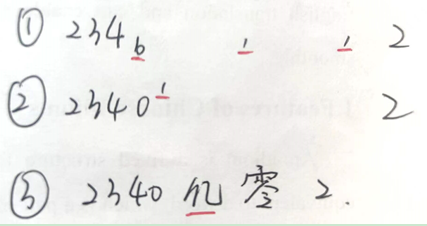
  1. large numbers with a lot of absent digits. 

    e.g. two hundred and thirty-four billion and two (234,000,000,002)

    The counting units "million" and "thousand" are absent in this number. We need to mark the units so as not to leave no digit behind.

    suggested steps:

  2. It is not necessary to write down the figure both in Chinese and English. Note taking is the means, not the end, so choose the most time-efficient way.

    common mistakes:
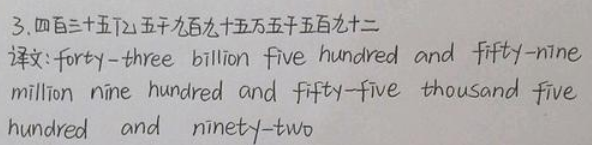
    suggested way:

Which way is faster?  Write down the figure in arabic numbers, and mark the counting unit with both superscript (上标) and subscript (下标) for conversion. 

3. Pay attention to the four elements in figure interpreting: the figure itself, its unit, the sentence subject or what the figure refers to, and the implied trend, the missing of anyone of which will lead to the failure of interpreting.