
Definitions of Nonverbal communication
To most people, nonverbal communication refers to communication effected by means other than words, assuming words are the verbal element. Nonverbal language refers to human emotional expressions without involving verbal statements. Facial expressions and body moments are the two mostly attributed types of nonverbal languages. It is generally believed that nonverbal languages function as the enhancement of emotional expressions when they consist with verbal languages.
The definition reads as "Nonverbal communication involves all those nonverbal stimuli in a communication setting that are generated by both the source and his or her use of the environment and that have potential message value for the source or receiver." (Samovar et al,2000) This definition includes the automaticity and control in nonverbal behavior. As with mist social activity, the production of nonverbal behavior is neither fully automatic nor fully controlled.
What is nonverbal language?
The process by which nonverbal behaviors are used, either singly or in combination with verbal behaviors.
The Functions of The Nonverbal Communication
(1)Repeating 重复
People use nonverbal communication to repeat, clarify, and emphasize their point of views.
Eg. A supervisor welcoming a subordinate back after a lengthy illness might give him a warm handshake to stress how pleased he is at the other's return.
(2)Complementing补充
Nonverbal communication cues can add to or complement a verbal message.
(3)Substituting替代
Nonverbal messages may substitute verbal ones in certain settings.
Eg. There are situations in which words cannot be used. In a very noisy street, for example, police officer might use hand gestures to replace spoken messages.
(4)Regulating规范
Nonverbal behaviors can help control verbal interactions by regulating them, such as turn-taking signals (hand raised) in conversations
(5)Contradicting 反驳
Certain nonverbal behaviors can contradict spoken words.
(6)Accenting强调
Nonverbal signals that accent call our attention to a matter under discussion
Eg. A person pounding on a desk as she makes an important point.
4. Types of non verbal communication
5. Study areas
(1)Chronemics
Even time can influence communication. We refer to the study of time as chronemics. Time can be classified into several different categories, including biological, personal, physical, and cultural time.
Biological time affects us when our natural rhythms are disturbed by all-nighters, jet lag, or other scheduling abnormalities. As a result, our physical and mental health and our communication competence and personal relationships may suffer.
Time management reveals a person’s status, and position, relationship, characters, commitment to an appointment.
Culture-specific
Monochronic Time 一元时间,单向计时制
Polychronic Time多元时间,多向计时制
(2)proxemics
When we are content with and attracted to someone, we say we are close to him or ,her, When we lose connection with someone, we may say he or she is distant." That is a clue to show space influences how people communicate and behave.
The study of such distance is called proxemics. The amount of space we maintain between each other during communication is the major sign to show how we feel towards the other party at that particular time.
Spatial use refers to how space is used between persons and how the arrangement and design of space affects communication.
What are the comfortable distance between you and your close friends, between you and your teacher, between you and your classmate, between you and a stranger?
As studies shown, Americans generally communicate with people 2 feet away from them. This varies according to the intimacy of people.
(3)Kinesics
The scientific study of the role of body movements, such as facial expressions, gestures, and eye movements, in interpersonal communication.
Gestures are probably the most commonly recognized cues of all body language.
(4)Elements of Nonverbal Communication
Body Language: Appearance
Posture and Walk
Gestures and Touch
Eye contact and Facial expressions
(5)Touch/Haptics
The study of touch is often referred to as haptics.
Touch can be welcoming, threatening, or persuasive. Think of how the touch of a friend or family has the power to comfort us in moments of sorrow when words alone cannot. Now, change the person who touches you to a total stranger. This positive power of touch is very likely to be countered by the risk of it turning into threats due to its connection to sex and violence. However, if the stranger is a doctor or tailor, your feeling could be entirely different. Why is that?
There are several types of touch, including functional-professional, social-polite, friendship-warmth, and love-intimacy.
For example, barbers, doctors, and security screeners touch us in ways related to a goal or part of a routine professional interaction, which makes it less threatening and more expected. On the other hand, a handshake and a pat on the shoulder are examples of touch at the social-polite level to help initiate interactions and show that others are included and respected.
Touch: except in families and among friends, usually the person with the greater power or higher status initiate touch.
Sensitive in workplace.
Inappropriate or unwanted touching— sexual harassment
Touch is influenced by gender and culture.
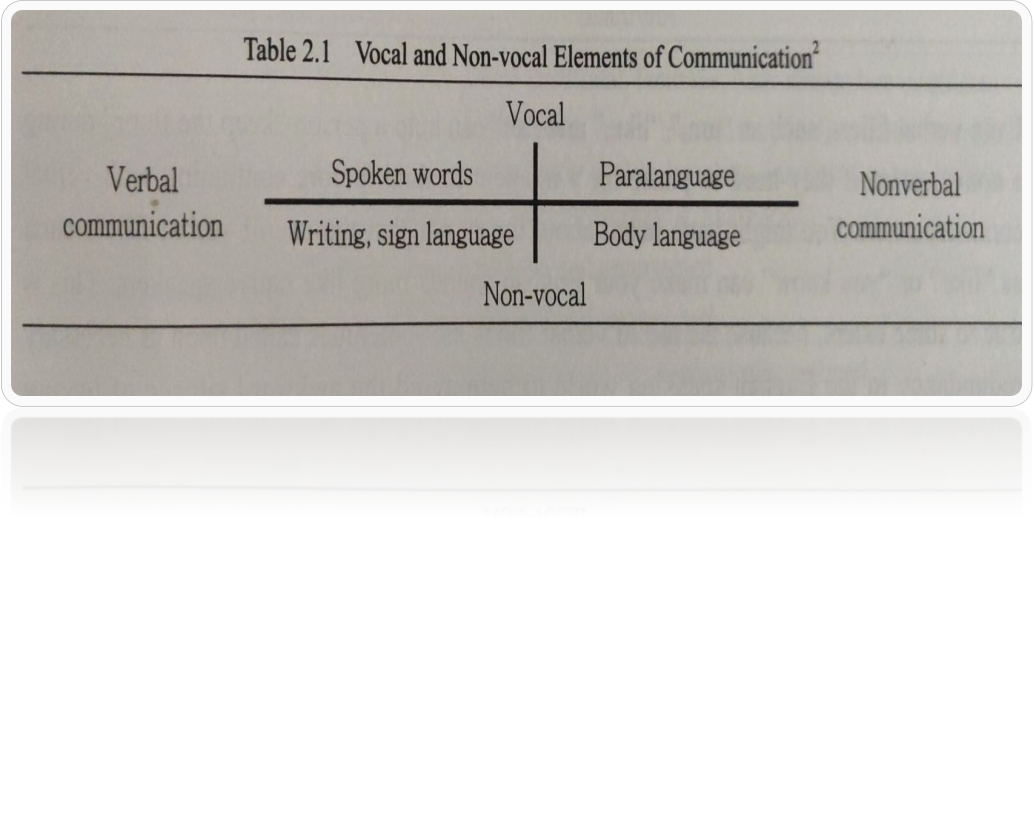
(6)paralanguage
The study of the vocal elements in communication is called paralanguage.
We all know that voice vary in their vocal elements such as pitch, volume, rate, tone and verbal fillers, but what you might not know is that these elements provide important context for the verbal content of speech.

